Do you need a first aid kit on a boat?
For a private leisure boat in the UK, usually not by law. You should still carry one, and the RYA suggests two.
The legal rules on medical kit at sea are the Merchant Shipping and Fishing Vessels (Medical Stores) Regulations 1995. The Maritime and Coastguard Agency (MCA) explains them in MSN 1905 (M+F), its notice on ships’ medical stores. It excludes pleasure vessels used for non-commercial purposes and not crewed by professionals: a boat used only for the sport or pleasure of the owner, their family or friends, where nobody pays more than a share of the running costs.
Chartering, taking paying passengers or paying crew can bring a boat inside the rules, so check with the MCA before you take money for a trip. The notice then sets the kit by how far from help the boat goes:
- Category A: seagoing, with no limit on the length of the voyage.
- Category B: trips of less than 150 nautical miles from the nearest port.
- Category C: harbour vessels and boats staying very close to shore (in UK terms, within 60 nautical miles of a safe haven), or with no cabin other than a wheelhouse.
The lists below follow the RYA’s first aid advice for inshore, coastal and offshore boating.
Boat first aid kit list: inland and coastal
For a day on a river, canal or the coast, carry a kit for small injuries plus the medicines your crew need.
The RYA advises a strong, damp-proof canvas bag or box, clearly labelled, with contents and dates checked regularly. On all but the smallest boats it suggests two kits: one for day-to-day use and one for incidents. Its coastal list:
Equipment
- Disposable gloves
- A thermal protective aid, to keep a casualty warm
- Triangular bandages and a supporting (crepe) bandage
- Tough-cut shears, for cutting through clothing
- Tweezers
- A resuscitation pocket mask
Wounds
- Plasters
- Wound dressings and an eye dressing
- Antiseptic wipes
- Cling film
Medicines
- Sun cream
- Seasickness tablets
- Paracetamol, ibuprofen and aspirin
- Antihistamine cream or tablets
- Indigestion tablets and a diarrhoea remedy
- Rehydration salts
- Any medicine your crew rely on, such as asthma treatment
For a short inshore trip the RYA’s list is shorter: plasters, wound dressings, triangular bandages, gloves, a thermal protective aid, sun cream, seasickness tablets, headache tablets and asthma treatment. Pack more regular medicine than the trip needs.
Offshore sailing first aid kit
Offshore, help can be a long way off, so the kit grows to match what your crew are trained to use.
The RYA’s offshore and ocean list opens with “depending on training”. On top of the coastal kit, it includes:
- Splinting equipment and a neck collar
- A thermometer, and a hypothermia thermometer that reads low temperatures
- A blood pressure monitor and a stethoscope
- A dental care kit
- Wound closure strips, burn dressings, paraffin gauze dressings, sterile dressings, tubular gauze and surgical tape
- For trained crews: a suture kit, scalpel and forceps, needles and syringes, suction equipment, oxygen and a defibrillator
It also adds medicines for a long passage, from sterile eyewash, laxatives and ear drops to antibiotics, very strong painkillers, local anaesthetic and treatment for anaphylaxis. The RYA points out that some can only be obtained on prescription, and that illegal possession could lead to prosecution. Ask your GP or pharmacist well before you sail. For a benchmark, MSN 1905 lists what a commercial boat carries in each category.
Getting medical help on the water
At sea or on the coast, HM Coastguard coordinates help, including medical advice from a doctor. Inland, call 999.
In a life-threatening emergency
- On a DSC VHF radio, send a distress alert by pressing and holding the distress button. Then, once it is acknowledged or after about 15 seconds, give a Mayday call on Channel 16 (GOV.UK small-boat procedures).
- Or call 999 and ask for the Coastguard. The RNLI says 999 or 112 both work, and to try even if your phone shows no service.
- Speak rather than text: the RNLI says texts and map locations are often no use to the Coastguard.
- Inland, on a river or lake, the RNLI says to ask for Fire and Rescue if someone is in difficulty in the water. For illness or injury aboard, ask for an ambulance.
Medical advice when it isn’t a Mayday
If someone is ill or hurt but not in immediate danger, call HM Coastguard on VHF Channel 16 or by DSC. The Coastguard puts you through, free, to a doctor at the Telemedical Advice Service (TMAS) at Queen Alexandra Hospital, Portsmouth, or Aberdeen Royal Infirmary. The MCA’s notice, MGN 623, is addressed to skippers of pleasure vessels too, and says not to rely on a mobile phone as your only means. Have this ready:
- What the illness or injury is
- The type of boat
- Your position
- Your next port, or the nearest place the casualty could be landed
If you are worried about someone’s safety but it isn’t a distress, the GOV.UK procedures use an urgency call, Pan Pan.
Before you go
The RYA’s advice: tell someone at home where you are going and when you expect to be back. If you are late, they call 999 and ask for the Coastguard. Carry a reliable way to call for help, such as a VHF/DSC radio, a personal locator beacon or a phone in a waterproof pouch. Ofcom’s ship radio licence is free online, and the radio may only be used by, or under the supervision of, someone with at least the RYA-run Short Range Certificate.
Hazards that come with boats
Plan for four things on any boat: cold water, the cold itself, seasickness and carbon monoxide.
Cold water shock: Float to Live
The RNLI says water below 15°C can cause cold water shock, when you lose control of your breathing and movement. The first effects pass in less than a minute, so don’t try to swim straight away. Its Float to Live advice:
- Tilt your head back, with your ears under the water.
- Relax and control your breathing.
- Move your hands and legs to help you stay afloat.
- Your legs may sink. That’s OK: everyone floats differently.
- Practise at a supervised location to find your float.
Hypothermia
The NHS lists falling into cold water and getting cold in wet clothes among the causes. Signs include shivering, slurred speech, slow breathing, and tiredness or confusion. Get them sheltered, out of wet clothes and wrapped up with their head covered, and call for help. Don’t rub their limbs, give alcohol, or use a hot bath, hot water bottle or heat lamp. Our hypothermia guide has the full steps.
Seasickness
The NHS advice: sit in the middle of the boat, look at a fixed point such as the horizon, and get fresh air. Don’t read or use screens, don’t watch the rolling waves, and avoid heavy meals, spicy food and alcohol. Ginger is worth a try. A pharmacist can recommend tablets or patches; patches are for adults and children over 10.
Carbon monoxide on boats
The Boat Safety Scheme (BSS) says carbon monoxide can build up from engine or generator exhaust, flue gases from a solid fuel stove, faulty or misused appliances, or too little air for fuel to burn properly. Never use a cooker to heat the cabin.
Since 1 April 2019 the BSS has required at least one CO alarm on nearly all boats in its scope that have an accommodation space: a cabin or other enclosed space used for sleeping, cooking, eating, washing or steering. It advises a certified alarm to BS EN 50291-2, tested routinely, with the batteries never removed.
Headache, dizziness, feeling sick, weakness and confusion can all be signs. The NHS advice: stop using the appliance if you can, go outside and get medical advice. Call 999 if someone is struggling to breathe, suddenly confused or unconscious. More in our CO alarm guide.
First aid training for boaters
A kit is only as good as the person using it. The RYA First Aid course is built around first aid afloat.
The RYA First Aid course is a 1-day classroom course, MCA approved, for anyone who goes afloat, from inland waters to cross-Channel passages. It covers the recovery position in a confined space, CPR with the drowning protocol, cold shock and hypothermia, seasickness and dehydration, medical advice by VHF and helicopter rescue, plus bleeding, head injuries and first aid kits. It also meets the first aid requirement for the RYA’s Coastal Skipper, Yachtmaster and Advanced Powerboat certificates of competence.
Between courses, our CPR guide is a quick refresher on adult CPR.
Liveaboards and narrowboats
If the boat is your home, it needs a home first aid kit as well as a boat one.
- Keep a full kit, as in our home first aid kit guide, plus enough of your regular medicines to last several days.
- In an emergency on Canal & River Trust waters, call 999 first. The Trust’s 24-hour line, 0800 47 999 47, is for urgent problems that aren’t emergencies. On other waterways, note the navigation authority’s own emergency contacts.
- Work out how an ambulance would reach your mooring: the nearest road, bridge or lock.
- Fit and test CO alarms. You need a valid BSS certificate or exemption before you can buy a Canal & River Trust boat licence.
- Keep a battery or wind-up radio for news when the power and signal go (emergency radio guide), and check Live Watch for Met Office warnings before you set off.
- Size your batteries and power banks with our power bank calculator.
A ship’s medical library, offline
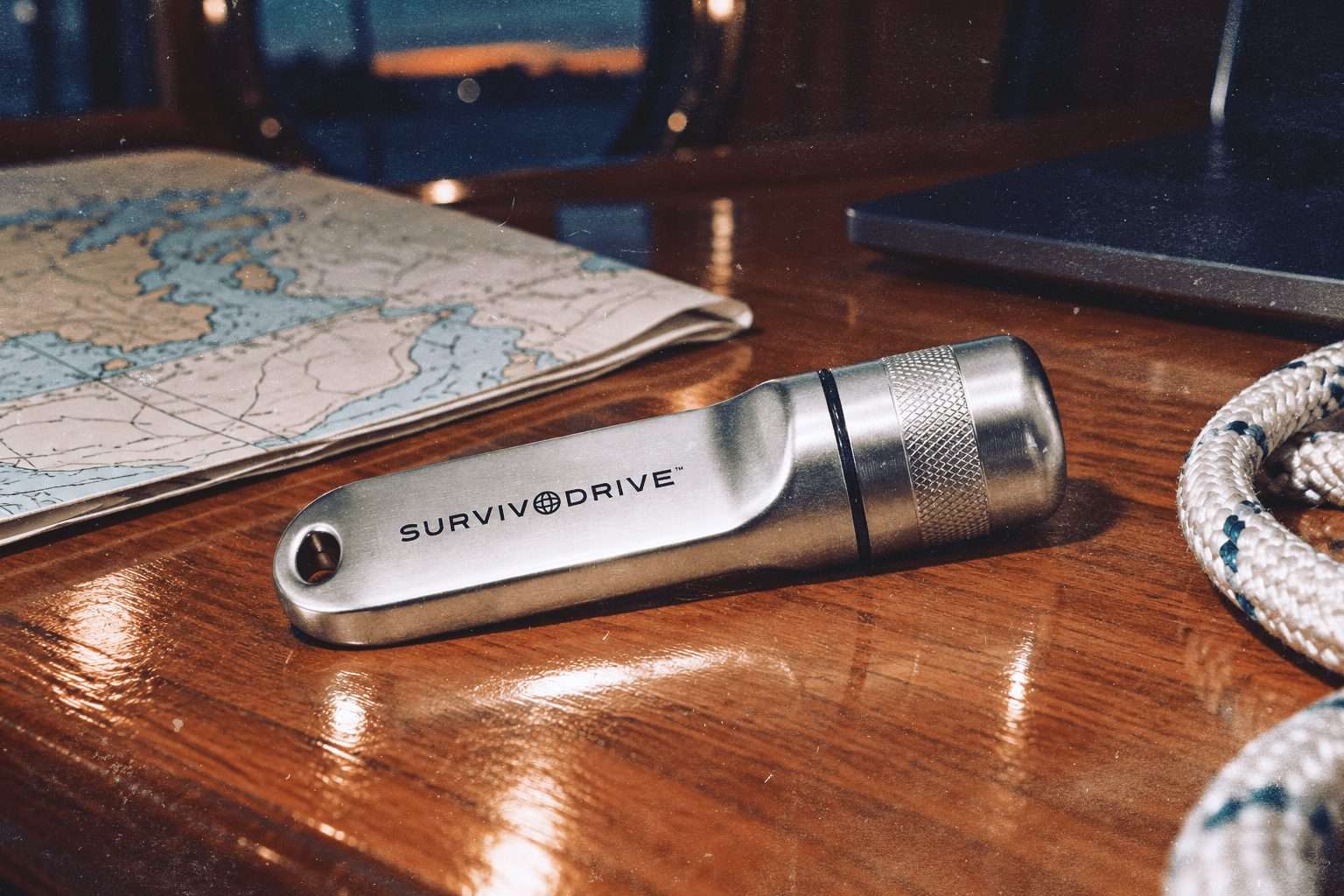
Out of signal, you can’t look things up online. SURVIVODRIVE keeps a ship’s medical library on a USB drive that needs no internet.
It is a 256 GB USB drive. Plug it into a laptop and double-click one file on Windows or Mac, or run it on a Raspberry Pi 4 or 5. Nothing is installed, and phones and tablets aboard join over that computer’s Wi-Fi. For sailors it holds:
- International Medical Guide for Ships, 3rd edition (WHO, ILO and IMO), for crews with no doctor, with a medicine chest list
- The Ship’s Medicine Chest and Medical Aid at Sea (2003 edition), written for lay people far from help
- Pub. 102 International Code of Signals, including the medical signal codes
- Where There Is No Doctor: A Village Health Care Handbook, WikiMed Medical Encyclopedia, WikEM and the current US Army first-aid manual
- National Interoperability Field Operations Guide (NIFOG) v2.02: its frequency plans are American, so not a guide to UK channels
- Hundred Rabbits: off-grid living, documented by two sailors
- A Library of Knots, and all of English Wikipedia with images
Core first aid guides are also plain PDFs in an EMERGENCY folder, which open on a phone or tablet with no computer running. A small local LLM assistant answers from the books with numbered sources, and says “Not on this drive.” when the answer isn’t there. Several medical books are American or international, so check medicine names and doses with a pharmacist; NHS’ Medicines A to Z is on the drive too. It is a reference, not a substitute for training or a call to the Coastguard.
Power is the limit afloat. The drive’s own plan puts a laptop at about 10 to 20 W while you read, and 30 to 60 W for a minute or two while the assistant writes. The power bank calculator shows how long your battery will last. Keep the drive cool and dry, out of direct sun.
SURVIVODRIVE is £69 with tracked UK delivery. It isn’t on sale yet: pre-orders open by email first, so join the pre-order list to hear when they do. See everything on it, or read how it works.
Questions
D-01Do you need a first aid kit on a boat in the UK?
Usually not by law, if it is a private pleasure boat. The Maritime and Coastguard Agency’s notice on ships’ medical stores, MSN 1905, excludes pleasure vessels used non-commercially and not crewed by professionals. Chartering, paying passengers or paid crew can bring a boat inside the rules. You should still carry one: the RYA suggests two on all but the smallest boats, one for everyday use and one for incidents.
D-02What should be in a boat first aid kit?
For coastal boating, the RYA lists gloves, a thermal protective aid, triangular and crepe bandages, tough-cut shears, tweezers and a resuscitation pocket mask. Add plasters, wound and eye dressings, antiseptic wipes and cling film. For medicines: sun cream, seasickness tablets, paracetamol, ibuprofen, aspirin, antihistamines, indigestion and diarrhoea remedies, rehydration salts and any medicine your crew rely on. Keep it in a strong, damp-proof, labelled bag or box and check dates regularly.
D-03What extra first aid kit do you need for offshore sailing?
Offshore, the RYA says the kit depends on training. Its offshore list adds splinting equipment, a neck collar, thermometers including a hypothermia thermometer, a dental kit, burn dressings and wound closure strips and, for trained crews, items such as a suture kit, oxygen and a defibrillator. Some medicines on the list, such as antibiotics and very strong painkillers, may need a prescription, so ask your GP or pharmacist well before you sail.
D-04How do you get medical help at sea in the UK?
In a life-threatening emergency, send a DSC distress alert and a Mayday on VHF Channel 16, or call 999 and ask for the Coastguard. For medical advice that isn’t a Mayday, call HM Coastguard on Channel 16 or by DSC: they put you through, free, to a doctor at the Telemedical Advice Service in Portsmouth or Aberdeen. Have the casualty’s problem, your position and the nearest place to land them ready.
D-05Do boats need a carbon monoxide alarm?
Yes, if the boat is in scope of the Boat Safety Scheme and has an accommodation space, such as a cabin used for sleeping, cooking, eating, washing or steering. The scheme has required at least one CO alarm since 1 April 2019, and advises a certified alarm to BS EN 50291-2, tested routinely, with the batteries never removed. You need a BSS certificate or exemption to license a boat with the Canal & River Trust.
D-06Can I use SURVIVODRIVE on a boat?
Yes, with a laptop, desktop or Raspberry Pi 4 or 5 aboard; phones and tablets join over that computer’s Wi-Fi. It holds the International Medical Guide for Ships, The Ship’s Medicine Chest and Medical Aid at Sea, Pub. 102 International Code of Signals and all of English Wikipedia, with no internet needed. A laptop draws about 10 to 20 W while reading. Pre-orders open by email first.