ReflashDo flash drives lose data? Yes, slowly. The SURVIVODRIVE Reflash Programme
Flash memory forgets. The Bureau does not.
Every USB stick is slowly forgetting
A flash drive stores each bit as a tiny electrical charge trapped in a memory cell. With no power, that charge leaks away, very slowly, and faster when the drive is warm. Leave any USB stick in a drawer for long enough and some of what it holds will no longer read back correctly. This is true of every flash drive made, not a flaw in one brand.
The industry writes the expectation into its standards. JEDEC’s endurance rules for client solid-state drives require data to survive one year unpowered at 30°C once a drive reaches its rated wear[1]. That is a minimum for heavily used SSDs, not a forecast for a new stick, but the direction is clear: charge loss is real and heat speeds it up[2]. Kingston, who make the drive inside SURVIVODRIVE, put it plainly: important information should always be backed up on other media for long-term safekeeping[3].
Reflashed every two years
- Month 00IssuedYour drive leaves the Bureau freshly written and checked.
- Month 24ReminderYou get a reminder that your drive is due.
- OnlineReflashPlug it into a computer with an internet connection and run the online reflash. The library is written back onto the drive and every file is checked against its SHA-256 checksum.
- Month 24+ReissuedBack in its case and back in the drawer, with a fresh two-year clock. It never left the house.
Standing orders
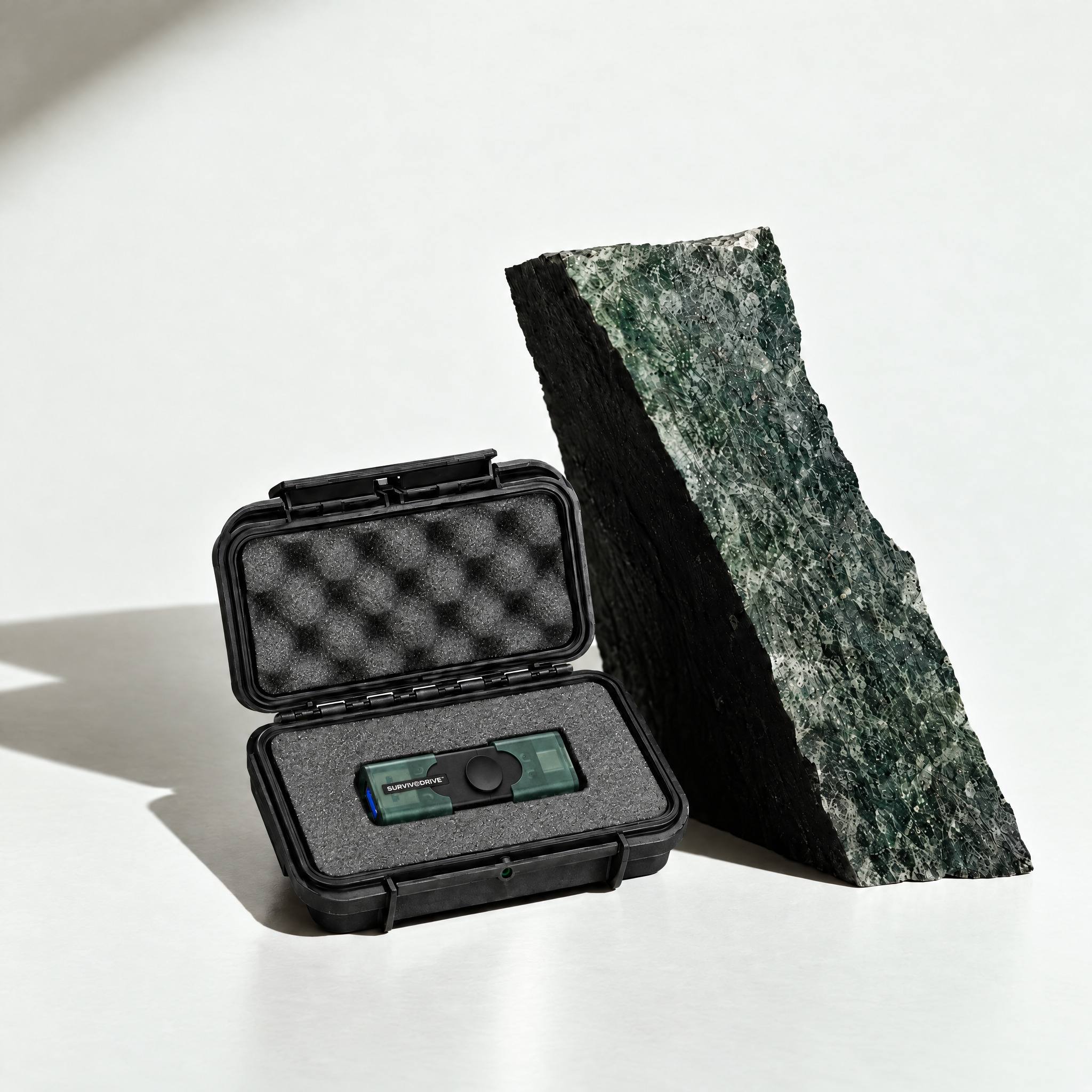
- i.Store the drive in its case, somewhere cool and dry. Heat is what ages flash fastest.
- ii.Plug it in and start it once or twice a year, so you know it works and everyone remembers how.
- iii.Print the first-aid and water guides from the EMERGENCY folder. Paper does not need reflashing.
- iv.Keep a second drive somewhere else. Two copies in two places beat one in a perfect drawer.
Put your drive on the register
Enter your drive’s serial and an email address, and the Bureau will tell you when it is due. That is the only thing the address is used for.
Reflash questions
D-01Do USB flash drives lose data over time?
Yes, slowly. Flash memory stores data as electrical charge, and that charge leaks away when a drive is unpowered, faster at higher temperatures. Kingston, the maker of SURVIVODRIVE's drive, advises keeping important data on other media too. SURVIVODRIVE's Reflash Programme reminds owners every two years to reflash the drive online, which writes every file afresh.
D-02Why does SURVIVODRIVE need reflashing every two years?
A survival library is only useful if it still reads after years in a drawer. Flash memory loses stored charge slowly when unpowered and faster in heat, and JEDEC's SSD standard only requires client drives at their wear limit to keep data for one year powered off at 30°C. Rewriting SURVIVODRIVE every two years refreshes every file on a fixed schedule instead of leaving it to chance.
D-03How long does food in the fridge last in a power cut?
SURVIVODRIVE's first-24-hours plan says fridge food stays safe for about 4 hours without power if the door stays shut, and a full freezer stays frozen for about 48 hours, or 24 hours if half full. Eat the fridge food first, then tins and dried food. Throw away meat, fish, dairy and leftovers that have been warmer than 4°C for over 2 hours.
D-04What does it mean to reflash SURVIVODRIVE?
Reflashing means rewriting every file on SURVIVODRIVE afresh and then checking each one against its SHA-256 checksum, so the data is newly written rather than years old. It exists because flash memory slowly loses stored charge when it sits unpowered, and faster in heat. Under the Reflash Programme, owners are reminded every two years to reflash the drive online, from a computer with an internet connection, so it never has to leave the house.
D-05Do I have to send SURVIVODRIVE away to be reflashed?
No. Reflashing is done online. When the two-year reminder arrives, plug SURVIVODRIVE into a computer with an internet connection and run the online reflash. It writes the library back onto the drive and checks every file against its SHA-256 checksum. The drive never leaves your hands.
D-06How do SHA-256 checksums show SURVIVODRIVE's files are intact?
Every file on SURVIVODRIVE has a SHA-256 checksum, a fingerprint calculated from its contents, recorded in the drive's inventory when it is built. Checking means recalculating each fingerprint and comparing it with the record. If any part of a file has changed or decayed, its checksum no longer matches. SURVIVODRIVE's build checks every download this way, and reflashing checks every file again.