DirectivesSURVIVODRIVE FAQ: 99 answers on the drive, the offline AI, power cuts, compatibility and the case
D-01–11The Drive
D-01What is SURVIVODRIVE?
SURVIVODRIVE is a 256 GB USB drive that holds an offline survival library and a small AI assistant. It covers medicine and first aid, water, growing food, building, power, radio, repair, maps and all of English Wikipedia with images. Everything runs from the drive with no internet connection, and the assistant answers questions from the drive's own books with numbered sources.
D-02What is a survival USB drive?
A survival USB drive is a flash drive loaded with reference material that works without the internet, such as first aid, water, food and shelter guides. SURVIVODRIVE is a 256 GB survival USB drive that adds all of English Wikipedia with images, an offline map, launchers for Windows, Mac and Linux, and a local AI assistant that answers from the drive's books with sources.
D-03Does SURVIVODRIVE need the internet to work?
No. SURVIVODRIVE is built to work with no internet at all. The library server and the AI assistant both run from the drive on the computer you plug it into, and nothing runs in the cloud. Phones and tablets connect to that computer over local Wi-Fi or a laptop hotspot, which works without any internet connection.
D-04How is SURVIVODRIVE different from other survival USB drives?
SURVIVODRIVE's assistant answers only from passages on the drive, cites them as numbered sources you can open, and says "Not on this drive." when they don't cover a question. It starts with a double-click on Windows and Mac, shares to phones over Wi-Fi, includes all of English Wikipedia with images, and comes with a Reflash Programme reminder every two years.
D-05What hardware is SURVIVODRIVE built on?
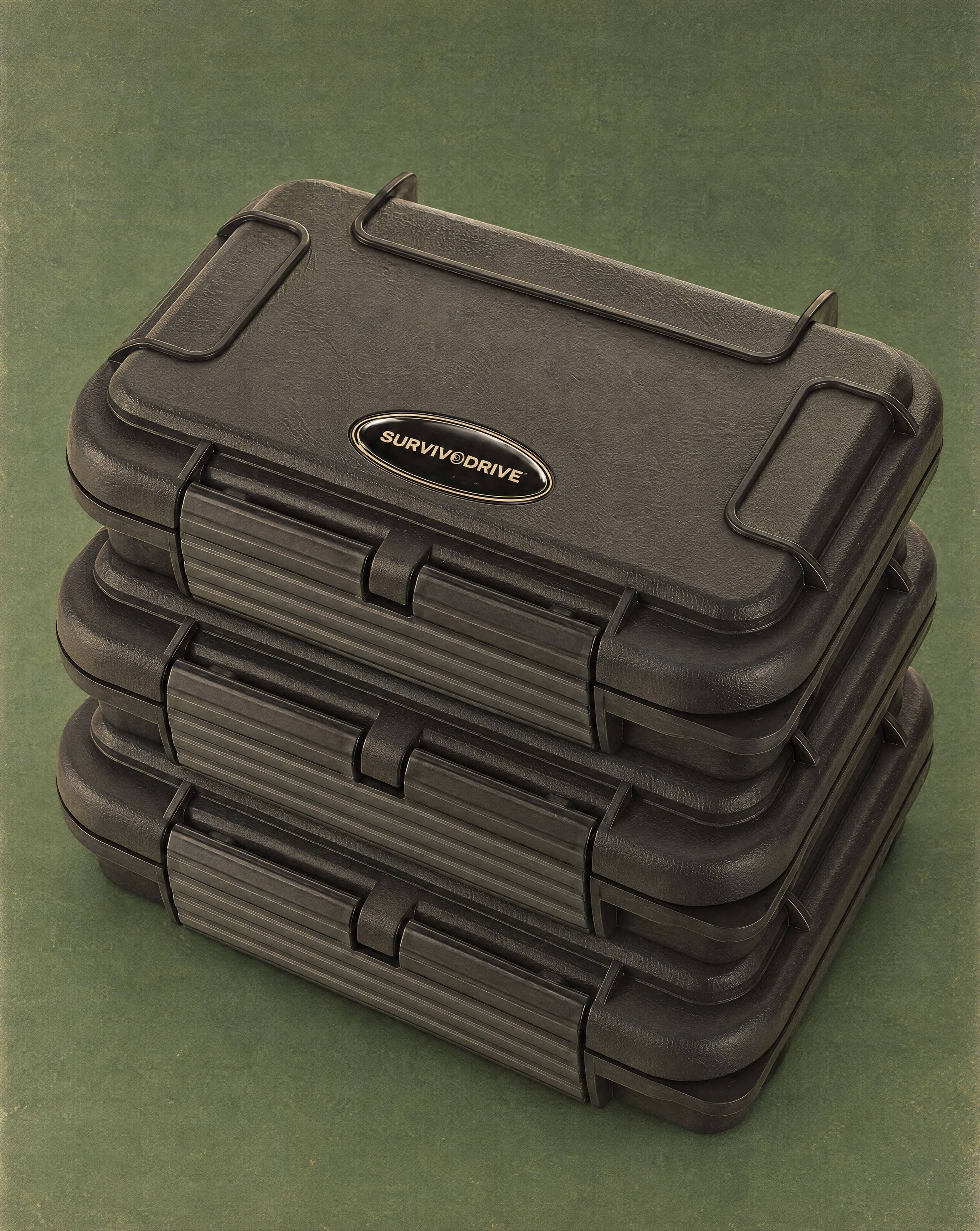
SURVIVODRIVE uses a 256 GB Kingston DataTraveler flash drive with both USB-A and USB-C connectors, so it plugs into older computers as well as newer laptops, tablets and phones without an adapter. It ships in a travel case certified IP67 for dust and water, with a temperature range of -10°C to +80°C.
D-06Is SURVIVODRIVE its own operating system?
No. SURVIVODRIVE is not an operating system and does not replace the one on your computer. It is a drive of files with launchers that start two programs from the drive: Kiwix, which serves and searches the library, and llama.cpp, which runs the AI. Your computer keeps working normally and nothing is installed on it.
D-07What is Survivipedia?
Survivipedia is the home screen that opens in your web browser when you start SURVIVODRIVE. It brings together a first-24-hours plan, twelve emergency quick cards, search across every collection, a topic library, PDF manuals, an offline map, a Share page with a QR code for other devices, and the AI assistant.
D-08How do I start SURVIVODRIVE?
Plug SURVIVODRIVE into a computer and run its launcher: double-click START-WINDOWS.bat on Windows or START-MAC.command on a Mac, or type sh start-linux.sh in a terminal on Linux or a Raspberry Pi. A window picks the AI model that suits the computer's memory, starts the library and opens Survivipedia in the browser.
D-09Does SURVIVODRIVE install anything on my computer?
No. SURVIVODRIVE runs its programs from the drive and installs nothing. If a computer blocks programs on removable drives, the launcher copies them to a per-user cache folder and runs them from there. Logs are kept in your user folder. Closing the launcher window stops both the library server and the AI.
D-10How big is the SURVIVODRIVE USB stick?
The flash drive inside SURVIVODRIVE is a Kingston DataTraveler Duo measuring 64 x 21.2 x 10.4 mm and weighing 10 g. It has both a USB-A and a USB-C connector, protected by sliding caps, and connects at USB 3.2 Gen 1 speed. It is stored in foam inside SURVIVODRIVE's IP67 travel case, whose internal space measures 157 x 82 x 41 mm.
D-11What file system does SURVIVODRIVE use?
SURVIVODRIVE is formatted as exFAT, the one format that Windows, macOS, Linux and Android can all read and write and that also allows files larger than 4 GB. That matters because some files on the drive are very large: all of English Wikipedia with images is a single file of about 127 GB. It also means the drive opens as an ordinary folder of files.
D-12–26What's On It
D-12What is on SURVIVODRIVE?
SURVIVODRIVE holds about 248 GB of offline knowledge, filled in priority order: medicine and first aid, water and sanitation, food and farming, shelter and tools, power and electrical, radio, repair, survival skills, all of English Wikipedia with images, an offline map, children's learning material and the AI models. Each item is listed with its size and the reason it was chosen.
D-13Does SURVIVODRIVE have all of Wikipedia offline?
Yes. SURVIVODRIVE carries all of English Wikipedia, around 7 million articles with images, taking about 127 GB of the drive. It is fully searchable offline through Survivipedia, and the AI assistant can draw on it. Simple English Wikipedia, Wikibooks, Wikiversity and Wikivoyage are included too.
D-14What medical and first aid information is on SURVIVODRIVE?
SURVIVODRIVE includes WikEM, an emergency medicine reference written by emergency doctors, the WikiMed and MDWiki medical encyclopedias, MedlinePlus from the US National Library of Medicine, the NHS medicines A to Z, the current US Army first-aid manual and US military field medicine. Twelve emergency quick cards cover bleeding, CPR, choking, burns and more.
D-15Does SURVIVODRIVE include survival manuals?
Yes. SURVIVODRIVE includes the current US Army survival manual (ATP 3-50.21), cold-weather and land-navigation manuals, FEMA's Are You Ready? preparedness guide, the CERT community emergency response manual, Nuclear War Survival Skills, and libraries of knots and post-disaster recovery guides. The manuals are searchable in short page ranges, so search results and AI citations open the right page.
D-16How does SURVIVODRIVE help with safe drinking water?
SURVIVODRIVE includes the EPA's emergency drinking-water disinfection sheet covering boiling and bleach dosing, US Army field-water and sanitation manuals, a solar water disinfection (SODIS) manual, a manual for hand-dug and hand-drilled wells, and a water treatment library. Safe water also has its own emergency quick card and a step in the first-24-hours plan.
D-17Does SURVIVODRIVE cover growing and preserving food?
Yes. SURVIVODRIVE includes the USDA Complete Guide to Home Canning, seed-saving guides, a 40,000-plant garden encyclopedia, guides to root-cellar storage, grain storage and fish ponds, and around 1,250 public-domain books on farming, livestock, forestry and beekeeping. Cooking, gardening and homebrewing question-and-answer archives are included too.
D-18Does SURVIVODRIVE have offline maps?
Yes. SURVIVODRIVE includes a zoomable offline OpenStreetMap of a region, showing roads, paths, towns and landmarks with no internet connection. The default region is the United Kingdom, which takes about 1.9 GB of the drive. Open it from the Maps collection in the Survivipedia library.
D-19Are there repair and engineering guides on SURVIVODRIVE?
Yes. SURVIVODRIVE includes step-by-step repair guides for electronics, appliances and vehicles, the US Army automotive manual, Navy construction, tools and electrician textbooks, Lessons in Electric Circuits, the Navy NEETS electronics course, and guides to solar, small wind and micro-hydro power. Radio manuals, antenna guides and emergency frequency references cover communications.
D-20Is there anything for children on SURVIVODRIVE?
Yes. SURVIVODRIVE includes Vikidia, an encyclopedia written for children aged 8 to 13, Simple English Wikipedia with images, a simple English dictionary, PhET interactive science and maths simulations, and interactive picture books for young children. A parenting question-and-answer archive is included as well.
D-21Can I search everything on SURVIVODRIVE at once?
Yes. The search box in Survivipedia searches every collection on SURVIVODRIVE at once and can be filtered by topic. Collections that ship without a search index get one built when the drive is made, and every PDF manual is split into searchable page ranges. A few collections, such as the Project Gutenberg books and the map, are browse-only.
D-22Is the US Army survival manual ATP 3-50.21 on SURVIVODRIVE?
Yes. SURVIVODRIVE includes ATP 3-50.21 Survival, the current US Army survival manual (2018), formerly published as FM 3-05.70 and FM 21-76. It covers water, food, fire, shelter, navigation, survival medicine, ropes and knots. It is searchable in the manuals library, sits as a plain PDF in the EMERGENCY folder, and the first-24-hours plan points to it for shelter, warmth and signalling for help.
D-23Does SURVIVODRIVE have the USDA Complete Guide to Home Canning?
Yes. SURVIVODRIVE includes the 2015 revision of the USDA Complete Guide to Home Canning, with tested, safe processing times for water-bath and pressure canning of fruit, vegetables, meat and pickles. It is kept as a plain PDF in the EMERGENCY folder and is searchable in short page ranges. The plan's "Food for the weeks ahead" section points to it for preserving food that would otherwise spoil.
D-24What is NIFOG and is it on SURVIVODRIVE?
NIFOG, the National Interoperability Field Operations Guide, is a pocket reference from the US Cybersecurity and Infrastructure Security Agency listing emergency, amateur, marine, FRS/GMRS, MURS and weather-radio frequencies and channel plans. SURVIVODRIVE includes version 2.02, alongside AUXFOG for amateur-radio emergency procedures and net operations. Both are US references, so their channel plans are American. The International Code of Signals on the drive is understood worldwide.
D-25Does SURVIVODRIVE's offline map cover the whole world?
No. SURVIVODRIVE's offline map is a zoomable OpenStreetMap of one region, chosen when the drive is built, and the default is the United Kingdom. For other countries, the drive carries the Wikivoyage travel guide with maps and photos, the 2020 CIA World Factbook covering every country's geography, and all of English Wikipedia with images. The US Army map reading manual covers navigating with a map and compass.
D-26Can SURVIVODRIVE help me fix a car or bicycle?
Yes. SURVIVODRIVE includes TM 9-8000 Principles of Automotive Vehicles, which explains engines, fuel, ignition, cooling, transmissions, brakes and electrical systems, and the Navy's Construction Mechanic Basic on petrol and diesel engines and small engines. Motor vehicle and bicycle question-and-answer archives cover maintenance and repair, and the Navy Steelworker manual covers cutting and welding metal parts.
D-27–41The AI Assistant
D-27How does the SURVIVODRIVE AI assistant work?
The SURVIVODRIVE assistant answers from the library, not from memory. For each question it searches the whole drive, reads the best passages from the top pages, and passes them to a local Qwen3.5 model with instructions to answer only from those numbered sources. Answers stream in with citations like [1] that open the original page or the right page of a PDF.
D-28Is the SURVIVODRIVE AI trained on survival books?
No. SURVIVODRIVE does not use a custom-trained model. It runs openly licensed Qwen3.5 models locally and uses retrieval: it finds relevant passages on the drive and asks the model to answer only from them, with numbered citations. That keeps answers tied to named books you can open and check, rather than to whatever the model memorised.
D-29What happens when the SURVIVODRIVE assistant doesn't know the answer?
When the passages it finds don't cover a question, the SURVIVODRIVE assistant replies "Not on this drive." It then gives a short suggestion from the model's general knowledge in a separate box, clearly labelled as unverified, with a link to search the library for the question. Nothing on the drive confirms what is in that box.
D-30Which AI models does SURVIVODRIVE use?
SURVIVODRIVE runs Qwen3.5 models locally and picks one to suit the computer's memory: a 2B fallback for 4 to 6 GB, the 4B default for 6 GB or more, a 9B model for 16 GB and a 35B-A3B model for 32 GB. All are 4-bit quantised and run through llama.cpp, so nothing is sent to an online service.
D-31How accurate is the SURVIVODRIVE AI assistant?
The SURVIVODRIVE assistant is a small model and can make mistakes, so every answer shows its sources. In the project's 13-question test covering water treatment, medicine doses and other practical questions, the default Qwen3.5 4B model scored 12 out of 13 in its latest full run. Numbers that don't appear in the sources are underlined, and citations to sources that don't exist are flagged.
D-32Can I trust the SURVIVODRIVE AI for medical questions?
Use it to find the right page, then follow the book. For medicine, electricity, gas, chemicals and structures, SURVIVODRIVE tells you to open the cited source rather than rely on the summary. Give the person's age when asking about a medicine dose, so only the matching dose rows are used, and check every dose against the source.
D-33How fast does the SURVIVODRIVE assistant answer?
Speed depends on the computer. The estimated answer time for SURVIVODRIVE's default 4B model is 30 to 60 seconds on a typical 8-core laptop and about 10 seconds on Apple silicon. The first answer after starting is slowest while the model loads from the drive. Finding the passages takes well under a second.
D-34Can I see what the SURVIVODRIVE assistant read before answering?
Yes. Under every answer, "Show the passages the assistant read" displays the exact text SURVIVODRIVE gave the model. Each citation such as [1] links to the original article or to the right page of a PDF manual, so you can read the full context and check the answer for yourself.
D-35What computer does the SURVIVODRIVE AI need?
The SURVIVODRIVE assistant needs a 64-bit computer with at least 4 GB of memory. With 6 GB or more it uses the 4B model, which makes far fewer mistakes than the 2B fallback. On older or 32-bit machines the assistant stays off, but the full library, search and emergency guides still work.
D-36Does the SURVIVODRIVE AI send my questions anywhere?
No. SURVIVODRIVE's assistant runs entirely on the computer the drive is plugged into. There is no account and nothing runs in the cloud, so questions are not sent to any online service. Other devices on the same Wi-Fi can use the assistant through that computer, unless you start the drive in private mode so only it can connect.
D-37Is the SURVIVODRIVE assistant like an offline ChatGPT?
In one way: you type questions in plain words and it writes an answer. The difference is where answers come from. SURVIVODRIVE's assistant is a small Qwen3.5 model running on your own computer, and it answers only from passages it finds on the drive, with numbered citations, replying "Not on this drive." when they do not cover the question. It needs no internet and no account.
D-38What do More sources and Think carefully do on SURVIVODRIVE?
They trade speed for depth. More sources makes SURVIVODRIVE read more pages before answering: about 330 words from each of six sources instead of 230 words from four, which is slower but more thorough. Think carefully lets the model reason before it answers, which is much slower. If answers are taking too long, turn both off or restart with the fast model.
D-39Why does the SURVIVODRIVE assistant underline some numbers?
It is a safety check. SURVIVODRIVE compares every number in an answer, outside the general-knowledge box, with the numbers in the passages the model was given. A number that appears in none of them gets a dotted underline and a warning under the answer, so treat it as unchecked. Numbers from your own question, such as a child's age, are not flagged.
D-40How should I word questions for the SURVIVODRIVE assistant?
Ask in plain words, as you would ask a person. SURVIVODRIVE drops filler such as "how do I", guesses the topic and searches with the most specific words, and a short follow-up question borrows terms from the one before. For a medicine, include the person's age. If the reply is "Not on this drive.", search the Library yourself with other words.
D-41Are there books on SURVIVODRIVE the AI assistant cannot read?
A few. On SURVIVODRIVE, the ST 31-91B Special Forces Medical Handbook is a scan with no text layer, and about half of the FM 24-18 radio manual is scanned, so neither search nor the assistant can see those pages, though you can read them as PDFs. Browse-only collections, about 13% of the content, such as the Project Gutenberg books, video archives and the map, are also outside the assistant's reach.
D-42–51Power Outages & Grid-Down
D-42How does SURVIVODRIVE help in a power cut?
In a power cut, SURVIVODRIVE runs on a laptop's battery and shares its library to phones over Wi-Fi or a laptop hotspot. It starts in low battery mode, showing matching library pages instead of running the AI, and its emergency guides are plain PDFs that open on a phone. Printing the key guides in advance gives you a copy that needs no power at all.
D-43What is low battery mode on SURVIVODRIVE?
SURVIVODRIVE starts with the assistant switched off to save power: questions show the matching library pages instead of AI-written answers. Press "Start the assistant" when your power supply is safe, and "Switch it off to save battery" to turn it back off. For the lowest power of all, start the drive with the no-AI launcher option.
D-44Will SURVIVODRIVE still work if the grid is down for weeks?
SURVIVODRIVE needs only a working computer or phone and enough power to run it; it needs no internet, accounts or servers. Its first-24-hours plan ends with "What next" sections on making shelter last, a steady water supply, safe heating and cooking, hygiene and health, food for the weeks ahead, power and light, and people and routine.
D-45How do I keep SURVIVODRIVE powered when the electricity is off?
SURVIVODRIVE's guide recommends keeping the drive with a USB-C/OTG adapter, a power bank and a small solar charger. Run it on one laptop and let the family connect by browser, which uses far less power than several devices. The drive also carries solar, wind, micro-hydro and generator guides for longer outages.
D-46What is the first-24-hours plan on SURVIVODRIVE?
It is a step-by-step plan for the first day after a disaster: get away from danger, deal with injuries, shelter before dark, warmth and fire safety, water, toilets, letting people know where you are, food, and making the battery last. SURVIVODRIVE shows it in Survivipedia and as a web page in the EMERGENCY folder that opens with nothing running.
D-47What emergency quick cards are on SURVIVODRIVE?
SURVIVODRIVE has twelve emergency quick cards: bleeding, CPR, choking, burns, shock, hypothermia, heatstroke, poisoning, broken bones, dehydration, safe water and childbirth. They work without the AI assistant and link to the full guides on the drive. In an emergency, use the quick cards first and get trained help if there is any way to reach it.
D-48Can I get first aid information without the internet?
Yes. SURVIVODRIVE holds first aid and emergency medicine references that work with no internet or phone signal, including twelve quick cards, the US Army first-aid manual and the WikEM emergency medicine reference. Core first-aid guides are also plain PDFs in the EMERGENCY folder, so they open on a phone or tablet even when no computer is running.
D-49Does SURVIVODRIVE cover radio communication when phones are down?
Yes. SURVIVODRIVE includes US Army radio and antenna manuals, the NIFOG and AUXFOG emergency frequency and procedure guides, the International Code of Signals for distress signals and Morse code, and an amateur radio question-and-answer archive. The first-24-hours plan also covers letting people know where you are.
D-50What should I do with SURVIVODRIVE before an emergency?
Start SURVIVODRIVE on every computer in the house so you know it works, install Kiwix and PocketPal AI on every phone and tablet from the app store, print the first-24-hours plan and the first-aid and water guides, and keep the drive with a USB-C adapter, a power bank and a solar charger. A second copy kept elsewhere adds resilience.
D-51Should I put SURVIVODRIVE in my bug out bag or emergency kit?
SURVIVODRIVE is designed to live with an emergency kit: its travel case is certified IP67 for dust and water, weighs 0.14 kg and measures 175 x 115 x 47 mm. Keep it with a USB-C adapter, a power bank, a small solar charger and printed copies of the key guides, and keep a second copy somewhere else.
D-52–65Compatibility
D-52Does SURVIVODRIVE work on Windows?
Yes. SURVIVODRIVE runs on Windows 10 and 11 PCs with Intel or AMD processors, and on Windows 11 ARM laptops. Double-click START-WINDOWS.bat on the drive. On PCs with a supported graphics card the AI can use the GPU. Some work and school PCs block programs on USB drives; the emergency PDFs still open there.
D-53Does SURVIVODRIVE work on a Mac?
Yes. SURVIVODRIVE runs on Macs with Apple silicon or Intel processors: double-click START-MAC.command on the drive. On Apple silicon the AI uses the Mac's GPU. Intel Macs need macOS 13.3 or newer for the assistant. If macOS says it cannot verify the developer, choose Open Anyway in Privacy & Security.
D-54Does SURVIVODRIVE work on Linux and Raspberry Pi?
Yes. SURVIVODRIVE runs on 64-bit Linux PCs and on the Raspberry Pi 4 and 5, using self-contained programs that work on any distribution. Open a terminal in the drive's folder and type sh start-linux.sh. Older 32-bit boards, such as the Pi Zero, run the library and search but not the AI assistant.
D-55Can I use SURVIVODRIVE on my phone or tablet?
Yes. When SURVIVODRIVE is running on one computer, phones, tablets, laptops, smart TVs and e-readers on the same Wi-Fi can open it in their web browser, including the AI assistant. Scan the QR code on the Share page or type the address shown in the launcher window. No app is needed for this.
D-56Does SURVIVODRIVE work on Android without a computer?
Yes. SURVIVODRIVE's ANDROID folder holds two apps you can install from the drive: Kiwix, which opens every library on the drive, and PocketPal AI, which runs the assistant's model files on the phone. On Android the assistant does not search the library itself, so look things up in Kiwix and ask PocketPal to explain.
D-57Does SURVIVODRIVE work on iPhone and iPad?
Partly. iPhone and iPad cannot install apps from a drive, so use SURVIVODRIVE through a computer's Wi-Fi share in the browser, or open the plain PDFs in the EMERGENCY folder with the Files app. SURVIVODRIVE's guide also recommends installing Kiwix and PocketPal AI from the App Store now, while the internet still works.
D-58Can several people use SURVIVODRIVE at the same time?
Yes. One computer runs SURVIVODRIVE and everyone else uses a web browser on the same Wi-Fi or network. With no router, the computer can create its own hotspot on Windows or Linux, or share over a cable or Internet Sharing on a Mac. One laptop serving the whole family uses far less power than several.
D-59Can I open SURVIVODRIVE's guides without starting anything?
Yes. SURVIVODRIVE's EMERGENCY folder holds a first-24-hours plan as a plain web page plus the most important guides as ordinary PDFs. They open on any phone, tablet, e-reader, smart TV or computer with a browser or PDF viewer, with no software running and no internet connection.
D-60What should I do if SURVIVODRIVE won't start on a computer?
Check the launcher window is still open and reload the page; the address is http://localhost:8370. If Windows blocks programs on USB drives, use another computer or the EMERGENCY PDFs. On a Mac, choose Open Anyway in Privacy & Security. On Linux, start SURVIVODRIVE with sh start-linux.sh rather than ./start-linux.sh.
D-61Does SURVIVODRIVE work on a Chromebook?
Partly. SURVIVODRIVE's launchers are for Windows, Mac and Linux, and it has no Chromebook launcher. A Chromebook can still use the whole library, including the assistant, through its browser when another computer is running the drive on the same Wi-Fi: scan the QR code on the Share page or type the address. The EMERGENCY folder's plain PDFs open in any browser or PDF viewer.
D-62Can I use SURVIVODRIVE on a smart TV?
Yes, in three ways. A smart TV with a web browser can open SURVIVODRIVE's library and assistant from a computer running the drive on the same Wi-Fi. An Android TV box can install the Kiwix app from the drive's ANDROID folder and read every library on the drive, using a USB mouse or the remote. And the EMERGENCY folder's plain PDFs open on a smart TV with no special software.
D-63Will SURVIVODRIVE work in an older USB 2.0 port?
Yes, more slowly. SURVIVODRIVE's USB-A plug fits older USB 2.0 ports, which are slower than the drive's USB 3.2 Gen 1 connection. The library jumps around inside large files and the AI reads gigabytes as it starts, so speed is what you notice. SURVIVODRIVE's notes say reading the AI model over slow USB 2.0 can add up to a few minutes to the first start.
D-64Can I run SURVIVODRIVE on a Raspberry Pi Zero?
Yes, as a library server only. The Raspberry Pi Zero and other 32-bit boards run SURVIVODRIVE's library and search, but not the AI assistant, which needs a 64-bit computer. Start it from a terminal in the drive's folder with sh start-linux.sh, then open the library in a browser on the Pi or on phones on the same network. For the assistant, use a Raspberry Pi 4 or 5.
D-65Does SURVIVODRIVE work on Windows 7, 32-bit Windows or Windows 10 on ARM?
Not fully. SURVIVODRIVE's Windows launcher is written for Windows 10 and 11. On 32-bit Windows it stops and points you to START-HERE.html in a browser, and Windows 10 on ARM cannot run the x64 programs it needs. On these computers the EMERGENCY folder's PDFs still open, and the library and assistant work in a browser when another computer runs the drive.
D-66–74Durability & Case
D-66Is SURVIVODRIVE waterproof?
SURVIVODRIVE ships in a travel case certified IP67. Under the IEC 60529 standard, IP67 means dust-tight and protected against temporary immersion in water up to 1 metre for 30 minutes. The case has a watertight seal and an automatic pressure release valve, so keep the drive closed in its case whenever it is not in use.
D-67What temperatures can the SURVIVODRIVE case handle?
The SURVIVODRIVE travel case is temperature resistant from -10°C to +80°C. Heat matters for the data as well as the case: flash memory loses its stored charge faster when warm, which is one reason the Reflash Programme reminds owners every two years to reflash the drive online.
D-68How big is the SURVIVODRIVE case and what is it made of?
The SURVIVODRIVE travel case measures 175 x 115 x 47 mm outside and 157 x 82 x 41 mm inside, and weighs 0.14 kg. It is made of polypropylene copolymer with heavy-duty nylon catches and a watertight seal, and the cases are stackable on a shelf or in a kit box.
D-69Is SURVIVODRIVE EMP-proof?
SURVIVODRIVE makes no EMP rating claim. Its case is a waterproof polypropylene case, not a Faraday enclosure. What SURVIVODRIVE does offer is resilience to internet and network outages: it runs on most Windows, Mac and Linux computers, shares to phones over local Wi-Fi, and keeps its core guides as plain PDFs. Its setup guide also recommends keeping a second copy somewhere else.
D-70Is SURVIVODRIVE military grade?
SURVIVODRIVE makes no military-grade or MIL-STD claim. Many of its manuals come from the US Army and Navy, but the hardware claims are specific: a 256 GB Kingston DataTraveler drive, a travel case certified IP67 for dust and water, a -10°C to +80°C temperature range, a watertight seal and an automatic pressure release valve.
D-71Why does the SURVIVODRIVE case have a pressure release valve?
Air pressure inside a sealed case changes with altitude and temperature, for example after a flight or a cold night. The automatic pressure release valve on the SURVIVODRIVE travel case balances that pressure so the lid still opens easily, while the watertight seal keeps water and dust out of the case.
D-72How should I store SURVIVODRIVE?
Keep SURVIVODRIVE closed in its case somewhere cool and dry, away from hot cars, lofts and radiators, because heat speeds up data loss in flash memory. Plug it in and start it once or twice a year so you know it still works, keep a second copy in another place, and reflash it online when the two-year reminder arrives.
D-73Is SURVIVODRIVE still waterproof when the case is open?
No. SURVIVODRIVE's IP67 rating, dust-tight and protected against immersion to 1 metre for 30 minutes, belongs to the travel case with its lid closed on the watertight seal. The Kingston flash drive itself has no waterproof rating. Keep the drive in the closed case whenever it is not plugged in, and close the lid fully before it goes back in a bag or kit.
D-74Can I keep SURVIVODRIVE in a car, shed or garage?
Check the temperatures. SURVIVODRIVE's travel case is rated from -10°C to +80°C and the Kingston drive from -20°C to 85°C in storage, but the drive is rated to operate only from 0°C to 60°C, so let it warm above freezing before plugging it in. Heat is the bigger long-term risk: flash memory loses stored charge faster when warm, so a cool, dry indoor spot is better.
D-75–82Reflash Programme
D-75Do USB flash drives lose data over time?
Yes, slowly. Flash memory stores data as electrical charge, and that charge leaks away when a drive is unpowered, faster at higher temperatures. Kingston, the maker of SURVIVODRIVE's drive, advises keeping important data on other media too. SURVIVODRIVE's Reflash Programme reminds owners every two years to reflash the drive online, which writes every file afresh.
D-76Why does SURVIVODRIVE need reflashing every two years?
A survival library is only useful if it still reads after years in a drawer. Flash memory loses stored charge slowly when unpowered and faster in heat, and JEDEC's SSD standard only requires client drives at their wear limit to keep data for one year powered off at 30°C. Rewriting SURVIVODRIVE every two years refreshes every file on a fixed schedule instead of leaving it to chance.
D-77What does it mean to reflash SURVIVODRIVE?
Reflashing means rewriting every file on SURVIVODRIVE afresh and then checking each one against its SHA-256 checksum, so the data is newly written rather than years old. It exists because flash memory slowly loses stored charge when it sits unpowered, and faster in heat. Under the Reflash Programme, owners are reminded every two years to reflash the drive online, from a computer with an internet connection, so it never has to leave the house.
D-78Do I have to send SURVIVODRIVE away to be reflashed?
No. Reflashing is done online. When the two-year reminder arrives, plug SURVIVODRIVE into a computer with an internet connection and run the online reflash. It writes the library back onto the drive and checks every file against its SHA-256 checksum. The drive never leaves your hands.
D-79How do SHA-256 checksums show SURVIVODRIVE's files are intact?
Every file on SURVIVODRIVE has a SHA-256 checksum, a fingerprint calculated from its contents, recorded in the drive's inventory when it is built. Checking means recalculating each fingerprint and comparing it with the record. If any part of a file has changed or decayed, its checksum no longer matches. SURVIVODRIVE's build checks every download this way, and reflashing checks every file again.
D-80Can I check my SURVIVODRIVE's data myself?
Yes. The simplest check is to plug SURVIVODRIVE in and start it. For a thorough check, a computer with Python 3.9 or newer and the project's builder can run python3 build.py verify with --target and the drive's location, which re-hashes every file against its SHA-256 checksum. Adding --quick compares file sizes only, which is faster but less thorough.
D-81How often should I check SURVIVODRIVE?
Use three intervals. Now, while everything works: start SURVIVODRIVE on every computer in the house so you know it runs. Twice a year: check it and any second copy, by starting it or running the project's verify command. Every two years: reflash it online when the reminder arrives, so every file is rewritten and checked against its SHA-256 checksum.
D-82Should I keep two copies of SURVIVODRIVE?
Yes, if you can. SURVIVODRIVE's build guide recommends two drives, one kept at home and one somewhere else, and its user guide says to check both twice a year. The drive is a plain folder of files, so a second copy can be made by formatting a large enough drive as exFAT and copying everything across. Kingston also advises keeping important data on other media.
D-83–97Preparedness
D-83What should I put in a power cut kit?
SURVIVODRIVE's guide suggests keeping the drive with a USB-C/OTG adapter, a power bank, a small solar charger and printed copies of the first-24-hours plan and the first-aid and water guides. Its first-24-hours plan adds a battery or wind-up radio for official news, and LED lamps or torches rather than candles, which are a common cause of house fires.
D-84How long will a power bank keep a laptop running SURVIVODRIVE?
Check the battery's capacity in watt-hours on its label. SURVIVODRIVE's first-24-hours plan gives rough figures: a laptop reading the library uses 10 to 20 W, rising to 30 to 60 W for a minute or two while the assistant writes an answer. A 300 Wh battery therefore gives roughly 15 to 20 hours of reading, or about 15 phone charges. Keeping the assistant off stretches it further.
D-85How do I charge a laptop or phone with a solar charger in a power cut?
SURVIVODRIVE's first-24-hours plan says to charge in full sun around midday, point the panel at the sun and turn it as the sun moves, and keep the battery itself in the shade. For a longer outage, set a daily charging routine around the midday sun and charge in this order: medical devices, radio, phones, torches and lamps, then the laptop.
D-86What information should I have offline before an emergency?
Start with what matters fastest: first aid, safe water, shelter and warmth, then food, power and communications. SURVIVODRIVE's library puts emergency medicine, water and first-aid manuals first, then the encyclopedia and practical collections. Its first-24-hours plan also asks you to find out who needs regular medicine, such as insulin, heart, epilepsy or asthma medicine, and how many days' supply they have.
D-87What should I deal with first after a disaster?
SURVIVODRIVE's first-24-hours plan works in order of what kills fastest: injuries in minutes, cold or heat in hours, thirst in days and hunger in weeks. So it starts with getting away from danger and checking everyone for injuries, then shelter before dark, warmth and water. Food comes near the end, because people last weeks without it but only days without water.
D-88How much water does each person need in an emergency?
SURVIVODRIVE's first-24-hours plan says each person needs at least 2 litres a day to drink, more in heat or hard work, and about 4 litres including cooking and washing. Drink what is already safe first, such as bottled water and the water in your pipes and hot-water tank, with its power or gas turned off. Never drink from radiators, heating boilers, waterbeds, pools or toilets.
D-89How long does food in the fridge last in a power cut?
SURVIVODRIVE's first-24-hours plan says fridge food stays safe for about 4 hours without power if the door stays shut, and a full freezer stays frozen for about 48 hours, or 24 hours if half full. Eat the fridge food first, then tins and dried food. Throw away meat, fish, dairy and leftovers that have been warmer than 4°C for over 2 hours.
D-90Are printed survival guides better than digital ones?
Each covers the other's weak spot. Paper needs no power or device, but it is heavy and slow to search. SURVIVODRIVE holds about 248 GB of searchable guides and all of English Wikipedia, with an assistant that finds the right page, but it needs a working computer or phone. SURVIVODRIVE's own guide recommends both: print the first-24-hours plan and the first-aid and water guides.
D-91Which SURVIVODRIVE guides should I print?
SURVIVODRIVE's guide says to print the first-24-hours plan, EMERGENCY/00-FIRST-24-HOURS.html, and the first-aid and water guides, and keep them with your emergency kit. The EMERGENCY folder holds the most important guides as plain PDFs, including the US Army first-aid manual, the EPA's two-page emergency water disinfection sheet and FEMA's Are You Ready? guide. The printed plan matches the on-screen one, because both come from the same data.
D-92How do preppers store digital information safely?
Keep more than one copy, in more than one place, in formats that open anywhere, and check them regularly. SURVIVODRIVE follows that pattern: its exFAT format works on Windows, macOS, Linux and Android, its key guides are plain PDFs, and its guide recommends a second copy kept elsewhere, checked twice a year. Kingston, the drive's maker, advises keeping important data on other media too.
D-93Is a survival USB drive worth it if I already have survival books?
Keep the books: they need no power. SURVIVODRIVE adds breadth and search. In one 10 g drive it holds about 248 GB, including all of English Wikipedia with images and manuals on medicine, water, food, building, power, radio and repair, all searchable at once, with an assistant that cites the page it used. SURVIVODRIVE's own guide still recommends printing the key guides.
D-94How do I make a family emergency plan?
Start with who, where and how you will reach each other. SURVIVODRIVE's first-24-hours plan says to count everyone and agree one place to meet if you get separated, leave a note on your door saying who is with you and where you have gone, agree check-in times with family and neighbours, and check on older or ill neighbours. FEMA's Are You Ready? guide on the drive covers household emergency planning and supply kits.
D-95What is the best way to protect survival information from an EMP?
Do not rely on any single electronic copy. SURVIVODRIVE is not EMP-proof, and its case is waterproof, not a Faraday enclosure. The practical protection is redundancy. Print the first-24-hours plan and the first-aid and water guides, which need no electronics to read, and keep a second copy of the drive in a different place, as SURVIVODRIVE's own guide recommends.
D-96How do I let family know I am safe if the phone network is down?
SURVIVODRIVE's first-24-hours plan suggests saving your phone battery with low-power mode and a dim screen, switching it off between checks, and sending texts rather than calling, because a text often gets through when calls do not. Listen to a battery or wind-up radio for official news. To call for help, use three of anything: three whistle blasts, three fires in a triangle or three flashes.
D-97Is it safe to use a camping stove or generator indoors in a power cut?
No. SURVIVODRIVE's first-24-hours plan warns that carbon monoxide kills without warning: never use a barbecue, camping stove, charcoal, fuel heater or generator indoors, in a tent or in a garage, and keep generators at least 6 m from doors and windows. If more than one person has a headache, dizziness, sickness or confusion, get everyone into fresh air at once.
D-98–99Buying & Shipping
D-98Is SURVIVODRIVE ready to use or do I have to build it?
SURVIVODRIVE arrives ready to use, with the library, AI models and launchers already on the drive. Building a comparable 256 GB library yourself means formatting a drive, installing Python tools and downloading about 250 GB, which takes roughly six hours at 100 Mbit/s, before the searchable manuals library and indexes are built.
D-99How do I pre-order SURVIVODRIVE?
Pre-orders for SURVIVODRIVE open by email first. Register your email address on the SURVIVODRIVE site and the Continuance Bureau will send a message when the pre-order drop goes live, with the details at that point. Registering does not commit you to buying anything; it only puts you on the list for the announcement.
Pre-order drop
Keep a copy of everything.
One for the house. One for the car. One for whoever always forgets.