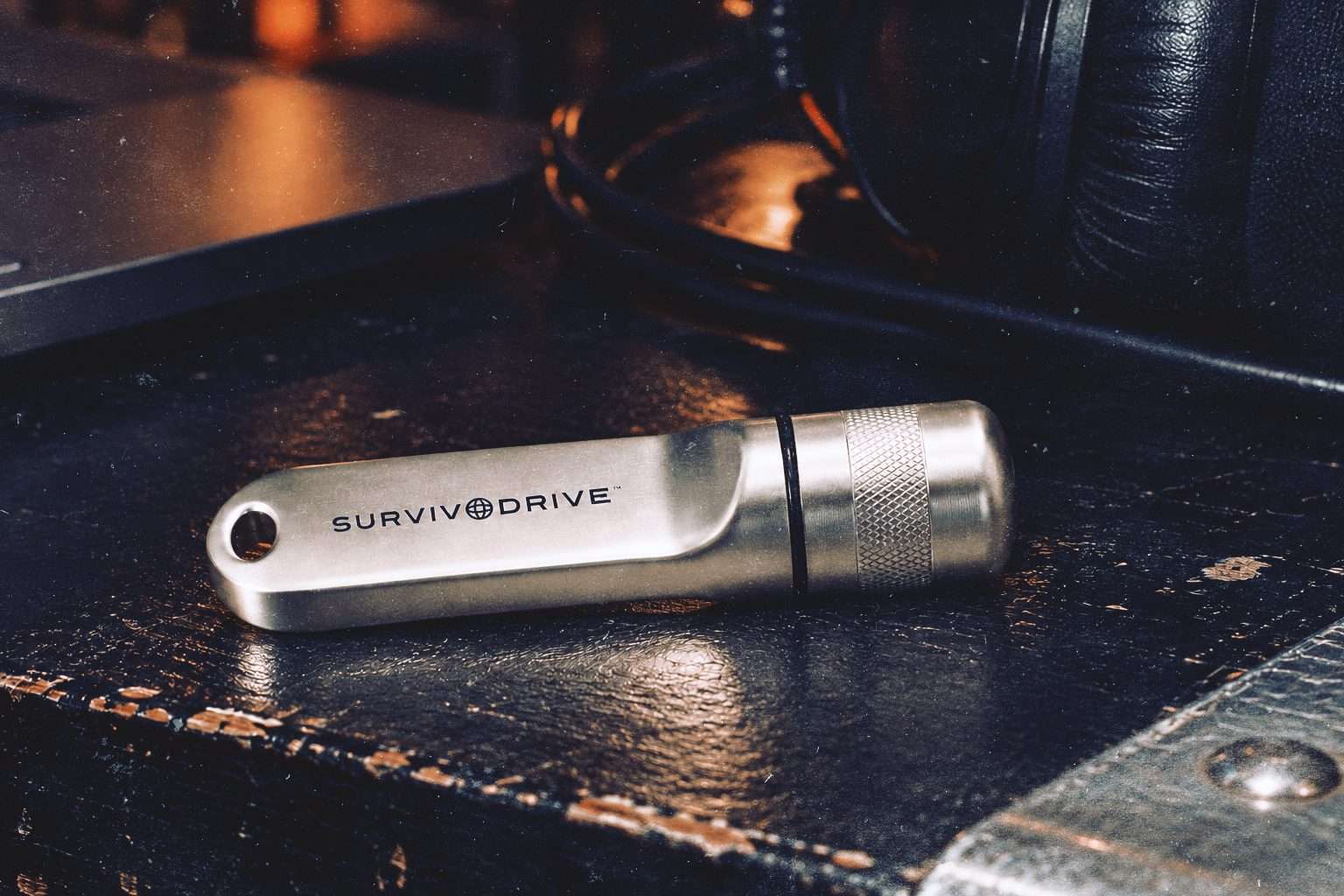
What is a survival USB drive?
A USB drive loaded with practical reference that works with no internet: first aid, water, food, shelter, power, repair and maps.
It is sold under a few names: survival flash drive, prepper USB stick, survival thumb drive, doomsday drive. They all do the same job. Plug it into a computer and read it like a website, with no signal and no account.
The good ones add three things a folder of PDFs cannot: search across everything at once, a map that zooms, and a way to ask a question in plain English and be shown the page that answers it.
Why keep one: most emergencies are boring
- INC-01A storm takes the power out.
- INC-02The mast goes quiet. No signal.
- INC-03Broadband is down until Thursday.
- INC-04The road is shut. The phone is on one bar.
- INC-05You are two valleys from anywhere.
That’s when you find out how much of what you know lives somewhere else.
SURVIVODRIVE keeps a working copy in the drawer. In a power cut it runs on a laptop’s battery, and the household reads it on their phones over the laptop’s own Wi-Fi.
What to put on a survival USB drive
Fill it in order of what keeps people alive: medicine first, then water, food, shelter, power, communication and repair.
| Shelf | Why it matters | On SURVIVODRIVE |
|---|---|---|
| First aid and medicines | Bleeding, burns, breaks, fevers and doses when help is slow | Where There Is No Doctor, US Army first aid manual, MSF Clinical Guidelines, NHS Medicines A to Z. 9 GB |
| Water and sanitation | Making water safe and keeping illness out of the house | WHO emergency water notes, EPA emergency disinfection, solar disinfection (SODIS). 0.1 GB |
| Food and growing | Storing, preserving and growing food | USDA home canning, FAO and extension guides, 1,250 farming books (browse only). 6 GB |
| Shelter, building and tools | Repairs to the house, carpentry, rigging | US Army and Navy trade manuals, Appropedia. 17 GB |
| Power | Batteries, solar and generators | Navy electricity and electronics series, solar PV practice. 7 GB |
| Radio | Listening and talking when phones are down | Radio field guides, amateur radio Q&A. 5 GB |
| Repair | Fixing what you already own | 100,000 iFixit guides, vehicle mechanics. 5 GB |
| Survival skills | Fire, shelter, navigation, knots | US Army survival manual, FEMA Are You Ready?, map reading. 17 GB |
| Maps | Getting somewhere with no signal | OpenStreetMap of the UK: roads, paths, towns. 2 GB |
| Everything else | The question nobody planned for | All of English Wikipedia with images, Wikibooks, Wikivoyage. 143 GB |
If you build your own, keep a paper copy of the few pages you would need first: first aid, water, and the phone numbers that matter. Paper needs no power.
How to choose the best survival USB drive: five checks
1. Where the content comes from
“Thousands of survival PDFs” tells you nothing. Look for named publishers and editions you could check.
SURVIVODRIVEEvery title is listed with its publisher in the full catalogue.
2. Whether it works the moment you plug it in
Some drives need software installed first, or only run on one operating system. You will not want to troubleshoot in the dark.
SURVIVODRIVEOne double-click on Windows or Mac, one command on Linux and Raspberry Pi. Nothing is installed.
3. Whether the assistant shows its sources, and what it can reach
An offline assistant is a small language model, and small models make things up. The useful ones answer from the books on the drive, show you the page, and reach nothing else: no internet, no account, none of your files.
SURVIVODRIVENumbered sources on every answer, “Not on this drive.” when the books are silent, and no access to anything but the library. How it works.
4. Whether it survives years in a drawer
Flash memory slowly loses the charge that holds your data when it sits unpowered, faster in the heat. A drive bought for a bad day has to read on that day.
SURVIVODRIVEA reflash reminder every two years.
5. Whether it fits where you live
A map of somewhere else is not much use. Nor are medicine names you do not recognise.
SURVIVODRIVEUK map by default and the NHS Medicines A to Z.
Survival USB drive vs Raspberry Pi hotspot (Prepper Disk), phone app or DIY
They hold similar libraries. The difference is what powers them and what you need to read them.
Looking for a Prepper Disk alternative that needs no separate power supply? A USB drive runs on the computer you already have.
| Type | How it works | Good at | Watch for |
|---|---|---|---|
| Survival USB drive | Plugs into a laptop or desktop. The library opens in the browser; phones join over the computer’s Wi-Fi. | Small to store. Uses the faster processor and memory of the computer you already own. | Needs a working computer with some charge. |
| Raspberry Pi hotspot | A small computer, such as Prepper Disk, that broadcasts its own Wi-Fi for phones to join. | No laptop needed. | Needs its own power supply. A small processor means slower answers from a language model, if it runs one at all. |
| Phone app | Libraries downloaded to the phone itself. | Always in your pocket. | Phone storage: Wikipedia with images alone is about 127 GB. One device, one battery. |
| Build it yourself | Kiwix and ZIM files on a drive you buy, plus a local language model if you want one. | Cheapest. Fully under your control. | About 250 GB of downloads, several hours of setup, and keeping it current. |
SURVIVODRIVE is the first kind, with a foot in the third: on Android it can also install Kiwix and PocketPal AI straight from the drive and run on the phone alone.
A survival USB drive set up for the UK
Many survival drives are built in the US, with US maps. SURVIVODRIVE’s offline map covers the United Kingdom by default, and its medicines reference is the NHS Medicines A to Z.
Many of the best field manuals are still American or international, from the US Army, the World Health Organization and Médecins Sans Frontières. Check UK numbers such as 999, 111 and the free power cut line, 105, separately. Our UK emergency kit list has them.
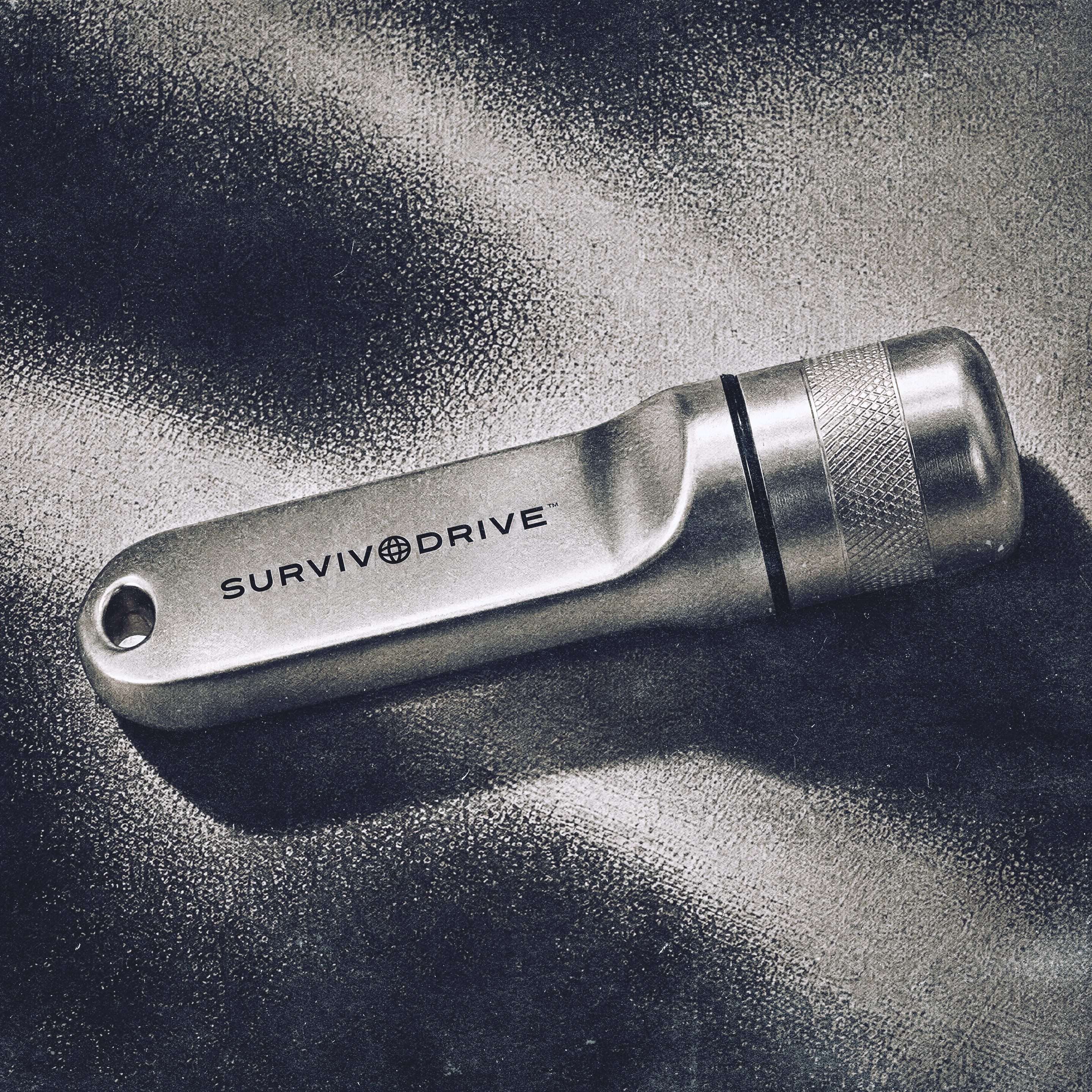
Keeping a survival USB drive working
- Keep it with the kit. Somewhere cool and dry, out of direct sun.
- Plug it in now and then. Start it once, so you know how before you need to.
- Refresh it. Rewrite the data every couple of years. SURVIVODRIVE owners get a reminder.
- Print the first pages. First aid and water guides, on paper, in the same box.
- Keep a second copy. In the car, or with family.
Questions
D-01What is a survival USB drive?
A survival USB drive is a flash drive loaded with reference material that works without the internet, such as first aid, water, food and shelter guides. SURVIVODRIVE is a 256 GB survival USB drive that adds all of English Wikipedia with images, an offline map, launchers for Windows, Mac and Linux, and a local assistant, a small language model, that answers from the drive’s books with sources.
D-02What should I put on a survival USB drive?
A useful survival USB drive covers first aid and medicines, safe drinking water, food and growing, shelter and tools, power, radio, repair, survival skills, maps and a general encyclopedia. Prefer named sources such as Where There Is No Doctor, WHO water guides and the US Army survival manual over unlabelled PDF bundles. SURVIVODRIVE carries all of these on 256 GB, with search across everything and a local language model that cites the page it used.
D-03What’s the difference between a survival USB drive and a Raspberry Pi hotspot like Prepper Disk?
A survival USB drive such as SURVIVODRIVE plugs into a laptop or desktop and uses that computer to serve its library and assistant; phones join over the computer’s Wi-Fi. A Raspberry Pi hotspot is a small computer that broadcasts its own Wi-Fi network for phones to join, so it needs its own power supply but no laptop. The USB drive is smaller to store and uses the faster processor and memory of the computer you plug it into.
D-04Is SURVIVODRIVE ready to use or do I have to build it?
SURVIVODRIVE arrives ready to use, with the library, language models and launchers already on the drive. Building a comparable 256 GB library yourself means formatting a drive, installing Python tools and downloading about 250 GB, which takes roughly six hours at 100 Mbit/s, before the searchable manuals library and indexes are built.
D-05Is SURVIVODRIVE EMP-proof?
SURVIVODRIVE makes no EMP rating claim. It is a flash drive, not a Faraday enclosure. What SURVIVODRIVE does offer is resilience to internet and network outages: it runs on most Windows, Mac and Linux computers, shares to phones over local Wi-Fi, and keeps its core guides as plain PDFs. Its setup guide also recommends keeping a second copy somewhere else.
D-06How is SURVIVODRIVE different from other survival USB drives?
SURVIVODRIVE’s assistant answers only from passages on the drive, cites them as numbered sources you can open, and says “Not on this drive.” when they don’t cover a question. It starts with a double-click on Windows and Mac, shares to phones over Wi-Fi, includes all of English Wikipedia with images, and comes with a Reflash Programme reminder every two years.