The UK government emergency kit list (GOV.UK Prepare)
GOV.UK Prepare suggests a small kit of everyday things, kept where everyone in the house can find it.
The Cabinet Office’s GOV.UK Prepare site lists:
- A battery or wind-up torch
- A portable power bank
- A battery or wind-up radio
- Spare batteries
- A first aid kit
- Hand sanitiser and wipes
- Bottled water
- Food that keeps and needs no cooking
- Baby supplies and pet food, if you need them
It also asks households to write important phone numbers on paper and keep them somewhere easy to find in a power cut: the power cut line, the people you would ring, regular medication, and insurance details.
Summarised from GOV.UK Prepare in October 2026. Check the site for the current list. SURVIVODRIVE is not part of government guidance.
What to do in a power cut in the UK: checklist
Call 105. It is free in England, Scotland and Wales, and it puts you through to your local network operator.
- Report it. Call 105, or use your network operator’s website. In Northern Ireland, call NIE Networks on 03457 643643.
- Use a torch. It is safer than candles, so avoid those where you can.
- Switch appliances off. Some should not be left running unattended when the power returns.
- Leave one light on. Then you will know as soon as the power is back.
- Keep your phone charged. Top it up from a power bank, and save its battery for calls and updates.
- Check on neighbours. Look in on anyone elderly or unwell, and make sure everyone has warm clothes, blankets and food.
Based on the Energy Networks Association’s advice, “What to do if you have a power cut”.
A laptop with a charge will run SURVIVODRIVE for the household: it starts in low battery mode, and phones read it over the laptop’s Wi-Fi. How it works in a power cut.
Grab bag list
A grab bag, or go bag, is the kit you take if you have to leave the house quickly.
- Prescription medicines, and a written list of them
- Copies of important documents and the paper list of phone numbers
- Phone, charger and a charged power bank
- Torch and spare batteries
- Some cash
- Water and snacks
- Warm layers and waterproofs
- Spare keys
- Glasses, hearing aid batteries, and anything else someone cannot do without
The part most kits forget: information
The radio brings news. The paper list brings numbers. Neither tells you how to treat a burn or make water safe.
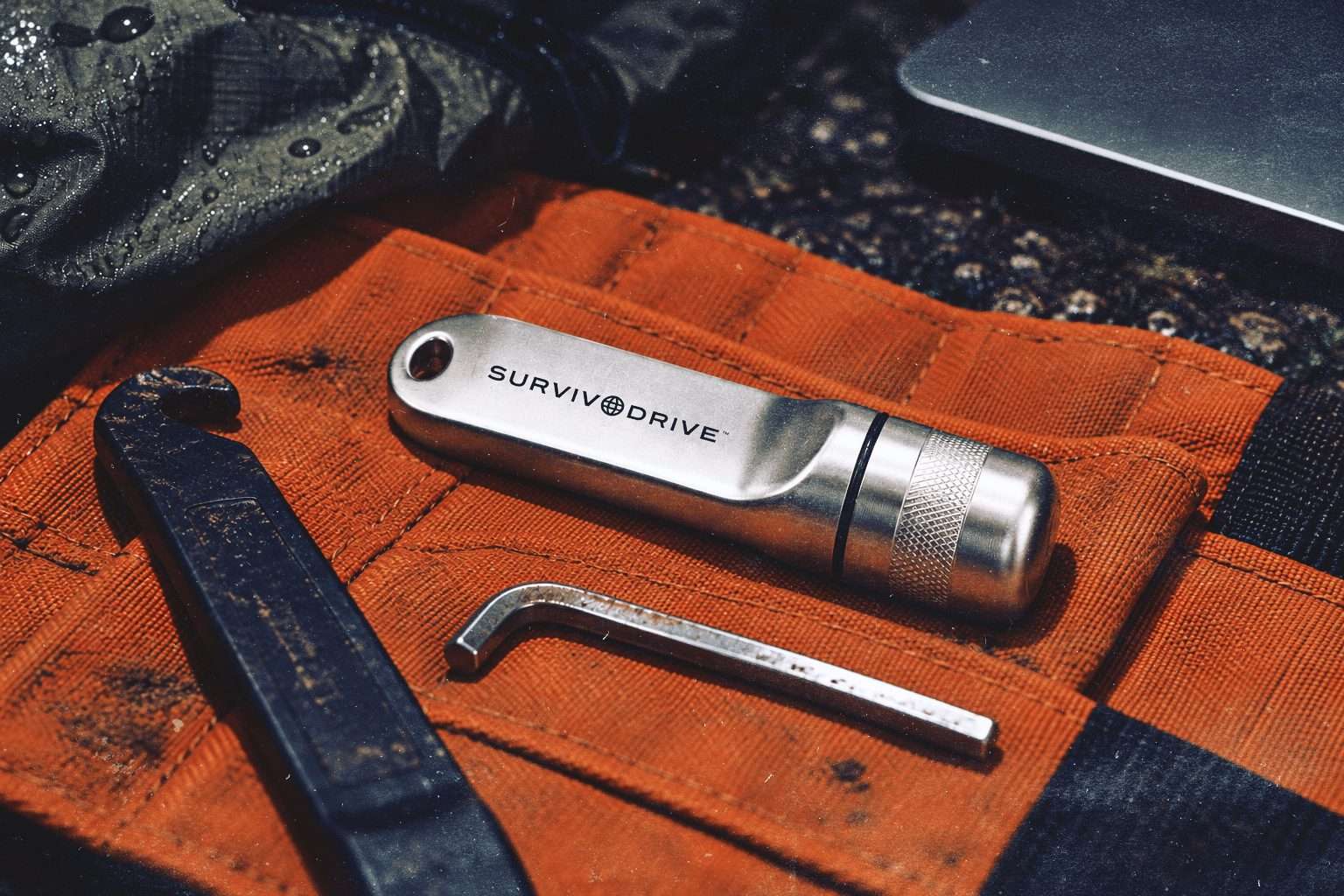
That is the gap SURVIVODRIVE fills. It is a 256 GB library that works with no internet: first aid and medicines, water, food, power, radio and repair manuals, all of Wikipedia, and an offline map of the UK. It is small enough to live with the rest of the kit.
It is not on the government’s list, and it does not replace anything that is. It answers the questions the list leaves open.
How long should a kit last?
A common rule of thumb is three days, known as a 72-hour kit. Plan for the household you have: children, pets, medicines, and anyone who needs power for equipment.
Check the kit when the clocks change. Swap the water and food before their dates, test the torch, charge the power bank, and plug in the drive.
Questions
D-01What should be in a UK emergency kit?
The UK government’s GOV.UK Prepare site suggests a battery or wind-up torch, a portable power bank, a battery or wind-up radio, spare batteries, a first aid kit, hand sanitiser and wipes, bottled water and food that keeps and needs no cooking, plus baby and pet supplies if needed. It also suggests writing important phone numbers on paper. In a power cut in England, Scotland or Wales, call 105 free. SURVIVODRIVE is not on the government list; it adds offline reference for first aid, water, repair and more.
D-02How does SURVIVODRIVE help in a power cut?
In a power cut, SURVIVODRIVE runs on a laptop’s battery and shares its library to phones over Wi-Fi or a laptop hotspot. It starts in low battery mode, showing matching library pages instead of running the assistant, and its emergency guides are plain PDFs that open on a phone. Printing the key guides in advance gives you a copy that needs no power at all.
D-03How do I keep SURVIVODRIVE powered when the electricity is off?
SURVIVODRIVE’s guide recommends keeping the drive with a USB-C/OTG adapter, a power bank and a small solar charger. Run it on one laptop and let the family connect by browser, which uses far less power than several devices. The drive also carries solar, wind, micro-hydro and generator guides for longer outages.
D-04Should I put SURVIVODRIVE in my bug out bag or emergency kit?
SURVIVODRIVE is designed to live with an emergency kit: it is a USB flash drive, small enough to live with the rest of the kit. Keep it with a USB-C adapter, a power bank, a small solar charger and printed copies of the key guides, and keep a second copy somewhere else.
D-05Can I get first aid information without the internet?
Yes. SURVIVODRIVE holds first aid and emergency medicine references that work with no internet or phone signal, including twelve quick cards, the US Army first-aid manual and the WikEM emergency medicine reference. Core first-aid guides are also plain PDFs in the EMERGENCY folder, so they open on a phone or tablet even when no computer is running.