Is off grid living legal in the UK?
Yes. The law looks at the home and what goes in and out of it, not at whether it is on the mains.
About 1% of people in England and 3% in Wales already drink from a private water supply, says the Drinking Water Inspectorate. The rules you will meet:
- Planning permission for a new home, a change of use or a caravan you live in
- Building regulations, or a building warrant in Scotland
- Council tax, or domestic rates in Northern Ireland
- Private water supply rules, run by your council
- Sewage rules for a septic tank or treatment plant
- Water licences for hydro power
- Smoke control rules for a wood burner
England, Wales, Scotland and Northern Ireland differ, and we say where.
Off grid living and planning permission
A new home, a change of use, or living in a caravan on land usually needs planning permission.
GOV.UK says you will probably need planning permission to build something new or change the use of a building. In England, the National Planning Policy Framework tells councils to avoid isolated new homes in the countryside, except in cases such as a rural worker who needs to live on site, or re-using a redundant building. Buying a field does not come with the right to live on it.
Caravans, cabins and mobile homes
In England, Scotland and Wales a caravan site on your land usually needs a site licence from the council, and planning permission before you apply. In Northern Ireland, nidirect says using a building or caravan in your garden as a separate home for someone else needs planning permission.
Wales: One Planet Development
Under the Welsh Government’s Technical Advice Note 6, a One Planet Development can be a single home in open countryside. Within 5 years the land should meet the residents’ minimum needs for income, food, energy and waste, and the home should be zero carbon to build and live in. The application needs a management plan (see the practice guidance).
Scotland and Northern Ireland
In Scotland you apply to your planning authority, usually the council, and a new home also needs a building warrant. In Northern Ireland, ask the council planning office first: build without permission and the council may make you put things right.
Building regulations
These are separate from planning, and you might need both. In England and Wales the Building Regulations 2010 cover new buildings and jobs such as a new fuse box or heating system. Use someone registered with a competent person scheme and you need not get approval yourself.
Council tax when you live off grid
Going off grid does not take a home out of council tax.
The bill depends on the home’s valuation band, the council’s charge and any discount or exemption, not on mains connections. In England and Wales, the Local Government Finance Act 1992 has a section on who pays where the home is a caravan pitch or boat mooring. Scottish Borders Council, for one, charges council tax on a caravan that is someone’s main home. Northern Ireland has domestic rates, billed by Land and Property Services.
Off grid solar, wind and hydro power
Off grid power is a system: something to make electricity, batteries to store it and an inverter to run the house.
Solar
Panels charge a battery bank through a charge controller, and an inverter turns that into mains-style power. Short winter days give far less, so plan a second source. Panels on a house or its land may be permitted development in England, within limits; Wales may differ. Our power bank calculator turns watt-hours into hours for a router, laptop or light.
Small wind
Winter is the UK’s windiest season, and hills, coasts and the north and west are windiest, says the Met Office. That makes a turbine on an exposed site a good partner for solar. Talk to your council’s planners before you put one up.
Micro-hydro
A year-round stream makes power day and night, and is the most regulated option. In England, most hydropower schemes need an Environment Agency abstraction licence or an impounding licence for a dam or weir. Natural Resources Wales issues both in Wales. In Scotland, SEPA requires a permit to take over 50 m³ a day for hydro. In Northern Ireland, DAERA says small hydro sites using over 100 m³ a day need abstraction licences.
Batteries and generators
A generator covers the dark weeks. The NHS lists portable generators as a source of carbon monoxide and warns against running engines in enclosed spaces, so run one outside, never in the house, a shed or a garage. Have a qualified electrician do the wiring. Our power cut guide covers the days the system fails.
Water: boreholes, springs and rainwater
Your own drinking water is a private water supply, and your council regulates it.
A private supply is any drinking water that does not come from a water company: a borehole, spring, stream or well, or rainwater if you drink it. Local authorities regulate them, under the Private Water Supplies (England) Regulations 2016 and the Private Water Supplies (Wales) Regulations 2017 (DWI).
- England and Wales: for a single home, the council does not have to risk assess or test unless you ask, and it can charge. Let the home, or run a holiday let, and the rules tighten.
- Scotland: the council keeps a register, and you can ask it to risk assess and test a small supply. A grant of up to £800 helps fix an unsafe supply, though not one serving a new building. The rules: the Water Intended for Human Consumption (Private Supplies) (Scotland) Regulations 2017 and the Private Water Supplies (Scotland) Regulations 2006.
- Northern Ireland: under the Private Water Supplies Regulations (Northern Ireland) 2017, a single home’s supply does not have to be monitored, but council environmental health can test it.
Taking the water can need a licence. In England, taking more than 20 cubic metres a day is likely to need an abstraction licence, and for a borehole, check first whether you need consent to investigate the groundwater. In Wales, ask Natural Resources Wales.
Test before you rely on it. Our guides cover making water safe to drink and a supply that stops, and the supply calculator sizes a store for a pump failure.
Sewage: septic tanks and treatment plants
Off the mains sewer, sewage goes to a septic tank or a small treatment plant, and each nation has rules.
- England, to ground: under the general binding rules, a septic tank or treatment plant drains to a drainage field, up to 2 m³ a day. A new system needs building regulations approval, and a registered waste carrier empties it at least once a year, or as the maker says. A home with a public foul sewer within 30 metres of its boundary cannot use these rules.
- England, to a stream or river: a small sewage treatment plant, not a septic tank, up to 5 m³ a day.
- Wales: most systems need a one-off, free registration with Natural Resources Wales; discharges to a watercourse need a package treatment plant.
- Scotland: if you cannot connect to the public sewer, you must apply to SEPA for an authorisation to discharge.
- Northern Ireland: septic tanks and treatment plants need a consent to discharge from the Northern Ireland Environment Agency.
Heating with wood
Fit the stove properly, feed it dry wood and put in a carbon monoxide alarm.
In a smoke control area you can only burn authorised fuel, unless your stove is a Defra-approved exempt appliance. In England a smoking chimney there can mean a penalty of up to £300. Your council can tell you if you live in one.
The Ready to Burn leaflet says to burn wood with 20% moisture or less, never treated wood or household rubbish, and to have the chimney swept up to twice a year.
In England, building regulations guidance since 1 October 2022 says a carbon monoxide alarm should be fitted with any new or replacement stove, boiler or other fixed combustion appliance. In Scotland, a home with a carbon-fuelled appliance, such as a boiler, fire or non-electric heater, or a flue, must have a carbon monoxide detector; that law does not cover caravans or mobile homes. The NHS advises one in each room with an appliance burning gas, oil, coal or wood. See our carbon monoxide guide.
Off grid internet and phone
With no fixed line, check mobile coverage first, then choose mobile broadband, fixed wireless or satellite.
Ofcom’s Map Your Mobile shows 4G and 5G coverage at your postcode, network by network. Each option needs power, so count the router in your budget.
If you cannot get 10 Mbit/s download and 1 Mbit/s upload, the broadband universal service lets eligible homes request a decent connection from BT, or KCOM in Hull. Work costing £3,400 or less is free to you; above that, you pay the excess.
For 999, Ofcom says a mobile should roam to another network if yours is down, but out of range of every network, no call is possible. Keep a battery or wind-up radio for news.
Food and storage
Grow what suits your land, preserve the gluts, and keep a store that needs no fridge.
A fridge and freezer run day and night, so size the battery bank with them in mind, and lean on tins, dry goods, preserves and a cool larder. Our guides cover food that keeps and what is safe after a power cut, and the UK foraging calendar shows what is in season each month.
What off grid living costs in the UK
It depends on the site, so here are the costs to plan for, not one figure.
We found no official UK figure. Price these for your site:
- Land, planning, surveys and building control
- Power: panels, turbine or hydro, batteries, inverter, generator and fuel
- Water: borehole or spring works, pump, treatment and council tests
- Sewage: tank or plant, drainage field and emptying
- Heat and internet: stove, fitting, wood, sweeping, equipment and a monthly plan
- Council tax or rates, and insurance
Keep the manuals offline
Keep the manuals you rely on where you can read them with no signal.
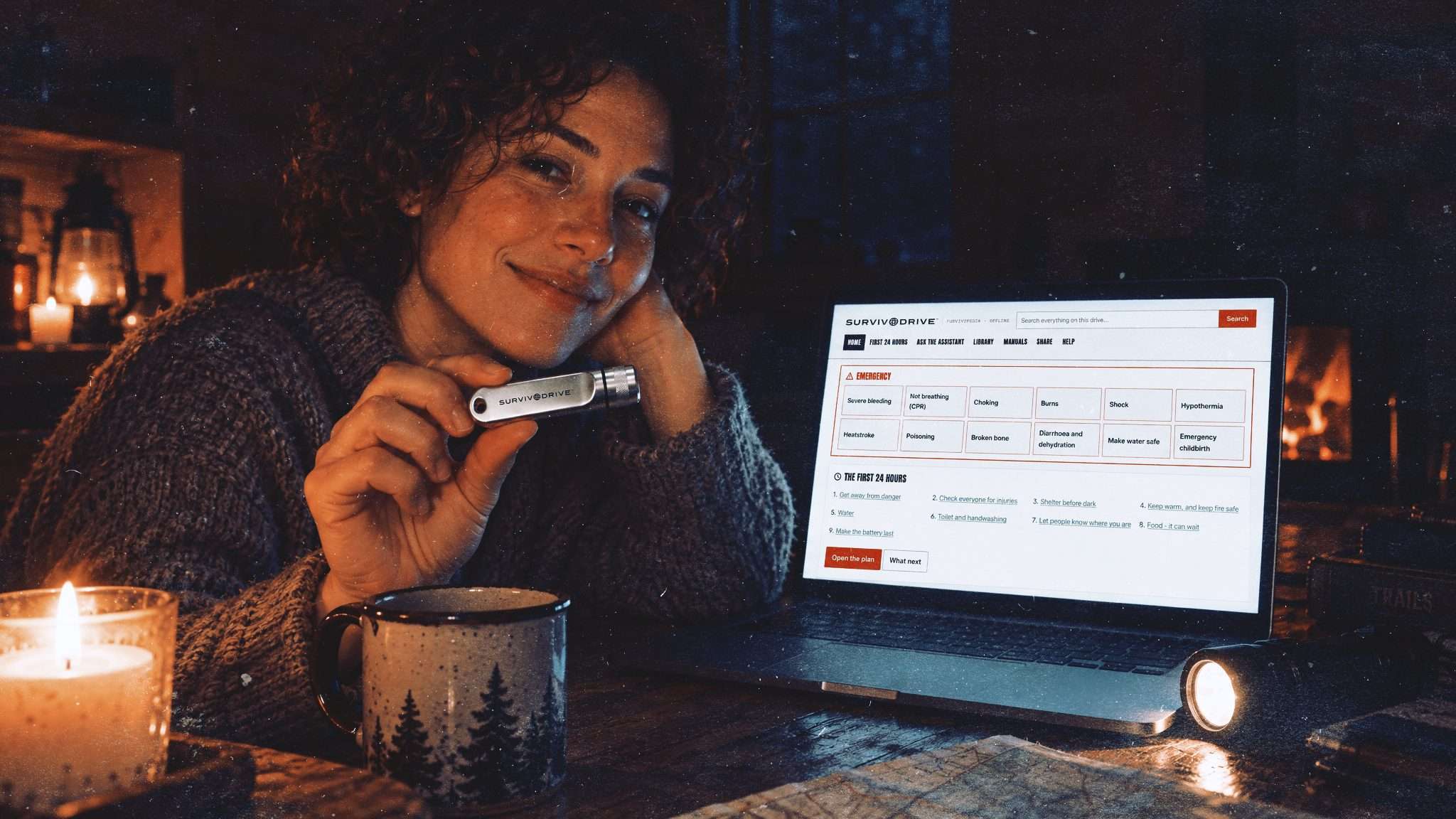
Keep the manuals for your own inverter, pump and stove on a laptop and on paper. For the rest there is SURVIVODRIVE, a 256 GB USB drive with all of English Wikipedia, field manuals, a UK map and a small local LLM assistant that answers from the drive with numbered sources. For off grid life it carries:
- Power: Photovoltaic Power Systems and the National Electrical Code: Suggested Practices; Micro-Hydropower Systems: A Buyer’s Guide; Small Wind Electric Systems: A U.S. Consumer’s Guide; energypedia; Solar Powered LowTech Magazine
- Water: Wells Construction: Hand Dug and Hand Drilled (Manual M-9), and water treatment manuals from the WHO, WEDC and Eawag
- Building: US Army, Navy, USDA and Peace Corps building manuals, Appropedia and the CD3WD Project
- Food: seed saving, home canning and food storage guides
- Repair: 100,000 repair guides from iFixit
Several are North American: the solar guide follows the US electrical code, the wind guide is written for US buyers and the hydro guide is Canadian. Use them for how the kit works, and UK rules and a qualified installer for how it goes in.
It needs a laptop, desktop or Raspberry Pi 4 or 5; phones and tablets join over that computer’s Wi-Fi. The assistant starts switched off to save power, and a laptop reading the library draws about 10 to 20 W.
It is £69 with tracked UK delivery. It isn’t on sale yet: pre-orders open by email first, so join the pre-order list to hear the moment they do. See what’s on it.
Questions
D-01Is it legal to live off grid in the UK?
Yes. Living off grid is legal in the UK: the rules apply to the home, not to being off the mains. A new home, a change of use or living in a caravan on land usually needs planning permission, plus building regulations approval or, in Scotland, a building warrant. Council tax still applies, or domestic rates in Northern Ireland. Your own drinking water is regulated by the local council, and a septic tank or treatment plant must meet your nation’s sewage rules.
D-02Do I need planning permission to live off grid in the UK?
Usually, yes, if you are building a new home, changing the use of land or a building, or living in a caravan on land. In England, the National Planning Policy Framework tells councils to avoid isolated new homes in the countryside, except in cases such as a rural worker who needs to live on site. Wales has a One Planet Development route for low-impact homes in open countryside. In Scotland and Northern Ireland, ask your council’s planning office first.
D-03Do you pay council tax if you live off grid?
Yes. Council tax depends on a home’s valuation band, the council’s charge and any discount or exemption, not on whether it is connected to the mains. In England and Wales, the Local Government Finance Act 1992 covers who pays where the home is a caravan pitch or a boat mooring, and Scottish Borders Council, for example, charges council tax on a caravan that is someone’s main home. Northern Ireland has domestic rates, billed by Land and Property Services.
D-04Who regulates a private water supply when you live off grid?
Your local council. Any drinking water that does not come from a water company, such as a borehole, spring or rainwater you drink, is a private supply. In England and Wales the council does not have to risk assess or test a single home’s supply unless you ask, and it can charge. Taking the water can need a licence too: in England, taking more than 20 cubic metres a day is likely to need an Environment Agency abstraction licence.
D-05How do you get internet off grid in the UK?
Check mobile coverage at your postcode with Ofcom’s Map Your Mobile checker, then choose mobile broadband, fixed wireless or satellite, all of which need your own power. If you cannot get 10 Mbit/s download and 1 Mbit/s upload, the broadband universal service lets eligible homes request a connection from BT, or KCOM in Hull. Work costing £3,400 or less is free to you; above that, you pay the excess.
D-06Is SURVIVODRIVE useful for living off grid?
Yes, for the days the internet goes down. It carries guides to solar, small wind and micro-hydro systems, energypedia, a well-building manual, water treatment manuals, building manuals, seed saving and canning guides, 100,000 repair guides and all of English Wikipedia. Several are North American, so pair them with UK rules. It needs a laptop, desktop or Raspberry Pi 4 or 5, and phones join over that computer’s Wi-Fi. Pre-orders open by email first.