Starting a smallholding: first steps
Register the land, then the animals, and find a vet. Do the paperwork before the animals arrive.
- Check your deeds allow livestock and ask the council if unsure, as nidirect advises.
- Find a farm vet and make a health plan with them (GOV.UK).
- Get a CPH number for the land, or register with DAERA in Northern Ireland.
- Get a flock or herd mark for sheep, goats, pigs, cattle or deer.
- Register any poultry, even 3 hens.
- Order official ear tags and start a holding register before the first birth or move.
- Set up an account for reporting moves.
- Know who will collect fallen stock.
- Buy proper feed: kitchen scraps are illegal for farm animals.
The CPH number
A CPH number is a 9-digit code for the land where you keep livestock, so animals can be traced if disease breaks out.
CPH stands for county parish holding. It looks like 12/345/0001: county, parish, then holding (Welsh Government). GOV.UK says you need one for livestock kept as a business, a hobby or a pet, such as a goat.
England: the Rural Payments Agency
Apply online through GOV.UK if you are 18 or over, or call 03000 200 301 (weekdays, 8:30am to 5pm). You can apply up to 6 weeks before the animals arrive. Since July 2026 you register once: the RPA passes your details to APHA, which emails your flock or herd mark, and to the British Cattle Movement Service if you keep cattle. Click the validation link in the RPA’s email within 12 hours. Renting land for more than a year needs its own CPH. Keeping fewer than 50 poultry? APHA issues the CPH when you register the birds.
Scotland: Rural Payments and Services
Register your business with the Scottish Government’s Rural Payments and Services, giving “to keep livestock” as a reason, then register your land. The Rural Payments and Inspections Directorate gives it a main location code, which is the CPH (Farm Advisory Service). Then register with APHA for a flock or herd number.
Wales: Manage My CPH
The Welsh Government says to apply through Manage My CPH on RPW Online, registering first if you are new. The Rural Payments Wales contact centre is on 0300 062 5004. Land within 10 miles of your main holding can share one CPH.
Northern Ireland: DAERA
Northern Ireland runs its own system through DAERA. You get a Business ID, plus an Animal Group Number, usually called a herd or flock number, for each species. Apply online or at a DAERA Direct office. Hobby keepers of backyard poultry, pet pigs or pygmy goats must register too.
Does a CPH number cost anything?
None of the official application pages we checked lists a fee. DAERA says registering to keep alpacas or deer costs nothing, and Scotland’s bird register is free. You do pay for ear tags.
Do I need a CPH number for chickens, sheep, pigs, goats or alpacas?
The list for England, from GOV.UK and APHA’s flock and herd mark guidance:
| Animal | CPH in England? | Also needed |
|---|---|---|
| Chickens, ducks and other poultry | Yes. Under 50 birds, APHA issues it | Register the birds within 1 month |
| Sheep and goats | Yes | Flock or herd mark, ear tags, holding register |
| Pigs, including pet pigs | Yes | Herd mark, identification before moving |
| Cattle | Yes | Herd mark, 2 ear tags, a passport |
| Deer | Voluntary, unless you move them | Herd mark |
| Alpacas and llamas | Voluntary | Tags, if used, from an approved sheep tag supplier |
| Horses, ponies and donkeys | Only to export them, or move them to the EU or Northern Ireland | A passport and microchip each |
Wales lists cattle, deer, sheep, goats, pigs, poultry (racing pigeons included) and equines for export. In Northern Ireland, alpacas and llamas must be registered with DAERA from 30 September 2026. In Scotland, ask your RPID area office.
Registering and identifying your animals
Each species has its own register, mark and tags. Get them in place before the first birth or move.
Chickens, ducks and other poultry
England and Wales: since 2024, every keeper must register with APHA within one month of keeping poultry or other captive birds, pets included. With fewer than 50 birds and no CPH, you can register online in about 10 minutes; 50 or more use a form. Confirm your details every 12 months. Budgies, canaries and parrots kept fully indoors are exempt.
Scotland: register on the free Scottish Kept Bird Register, even for one bird, and confirm your details at least once a year. It replaced the GB Poultry Register, so register again if you were on the old one.
Northern Ireland: DAERA’s Bird Register covers all keepers except pet birds kept in the owner’s home. Call 0300 200 7840 for a form.
In England and Wales, APHA contacts registered keepers if there is an outbreak, such as bird flu, in their area.
Keeping sheep and goats for beginners
Sheep and goats carry the most paperwork. In England you need to:
- Get a CPH number and a flock mark (a herd mark for goats).
- Tag lambs within 6 months of birth if reared indoors, 9 months outdoors, or before they leave the holding if sooner (GOV.UK).
- Use 1 electronic slaughter tag for a lamb slaughtered before 12 months old, or 2 matching tags, one electronic, for sheep you keep longer.
- Replace a lost tag within 28 days, and before the animal moves.
- Update your holding register within 36 hours of every move.
- Report every move to the Livestock Information Service.
- Count your flock on 1 December and return Defra’s annual inventory by 31 December.
Wales has similar tagging rules; the inventory goes to EIDCymru by 31 December, and the receiving keeper reports a move within 3 days (Welsh Government). In Scotland, sheep, pig and cattle keepers register with ScotEID to meet the movement rules. In Northern Ireland, lambs need an electronic tag set before 9 months old (6 if housed overnight) or before they move, every move off the holding needs a movement document, and records are kept for at least 3 years (DAERA).
Pigs, including pet pigs
One pet pig makes you a pig keeper, under the same rules as a farm (GOV.UK). In England a pig must carry an ear tag, ear tattoo or 2 slap marks with your herd mark before it leaves your land, with a few exceptions, and moves are set up in advance on eAML2, which also covers Wales. Walking a pet pig needs a yearly APHA licence. In Northern Ireland, register with DAERA before the pigs arrive and report moves off the holding within 7 days.
Cattle
In England and Wales, each calf needs 2 official ear tags, both within 21 days for a beef calf. Register the birth with the British Cattle Movement Service by day 27 to get its free passport; miss it and the calf cannot move or enter the food chain. In Northern Ireland you need a bovine herd number from DAERA.
Horses, ponies and donkeys
In England every horse, pony and donkey needs a microchip and a passport, kept with the animal and issued before it is 12 months old. Scotland, Wales and Northern Ireland have their own equine rules.
Alpacas and llamas
A CPH is voluntary for them in England. In Northern Ireland, DAERA requires registration from 30 September 2026, and animals not yet identified must be by 4 January 2027.
Rules that catch beginners out
Never feed kitchen scraps, never bury fallen stock, and report a notifiable disease straight away.
No kitchen scraps, not even peelings
You must never feed farm animals kitchen scraps or catering waste, vegetable or meat, from any household, vegan ones included (GOV.UK). That includes hens: nidirect says feeding chickens kitchen waste, vegetable scraps included, is illegal. The rule stops diseases such as foot and mouth spreading through feed.
Fallen stock: you can’t bury it
You must not burn or bury a dead farm animal, poultry included, on your land. Arrange for an approved transporter to collect it without undue delay and take it to a knacker, hunt kennel, incinerator or renderer; you pay (GOV.UK). The National Fallen Stock Company (01335 320014) runs a collection service. Horses are the exception: in England you may bury one, and in Scotland and Wales a pet horse.
Find a vet before you need one
Make a health plan with your vet, including isolating new animals. Some diseases are notifiable: suspect one and you must report it straight away, or you are breaking the law (GOV.UK). Call APHA on 03000 200 301 in England or 0300 303 8268 in Wales, your local APHA Field Services Office in Scotland, or DAERA on 0300 200 7840 in Northern Ireland.
Bird flu and housing orders
When the risk is high, birds can be ordered indoors. Last winter, England’s housing order ran from 6 November 2025 to 9 April 2026, for anyone keeping more than 50 birds or selling or giving away eggs, and every keeper had to tighten biosecurity. This season’s first case was confirmed on 2 October 2026, on the Isle of Lewis in Scotland. Check GOV.UK’s latest situation, and our guide to bird flu and dead wild birds.
The smallholding year
The paperwork has fixed dates. The growing follows the weather.
- 1 October: GOV.UK starts counting a new bird flu season. Plan where your birds would go under a housing order.
- 1 December: count your sheep and goats; in England and Wales the inventory is due by 31 December.
- Every 12 months: confirm your poultry registration.
- Before lambing: order official tags in advance, as DAERA advises.
- Winter: plan water, feed and freezers for power cuts, storms and snow, with our freezer timer. Live Watch shows current UK warnings.
For wild food in your hedges, use our UK foraging calendar (see what to forage in October), with the poisonous lookalikes to rule out.
A farm library that works with no signal
When the signal or the power goes, a library on a USB drive still opens.
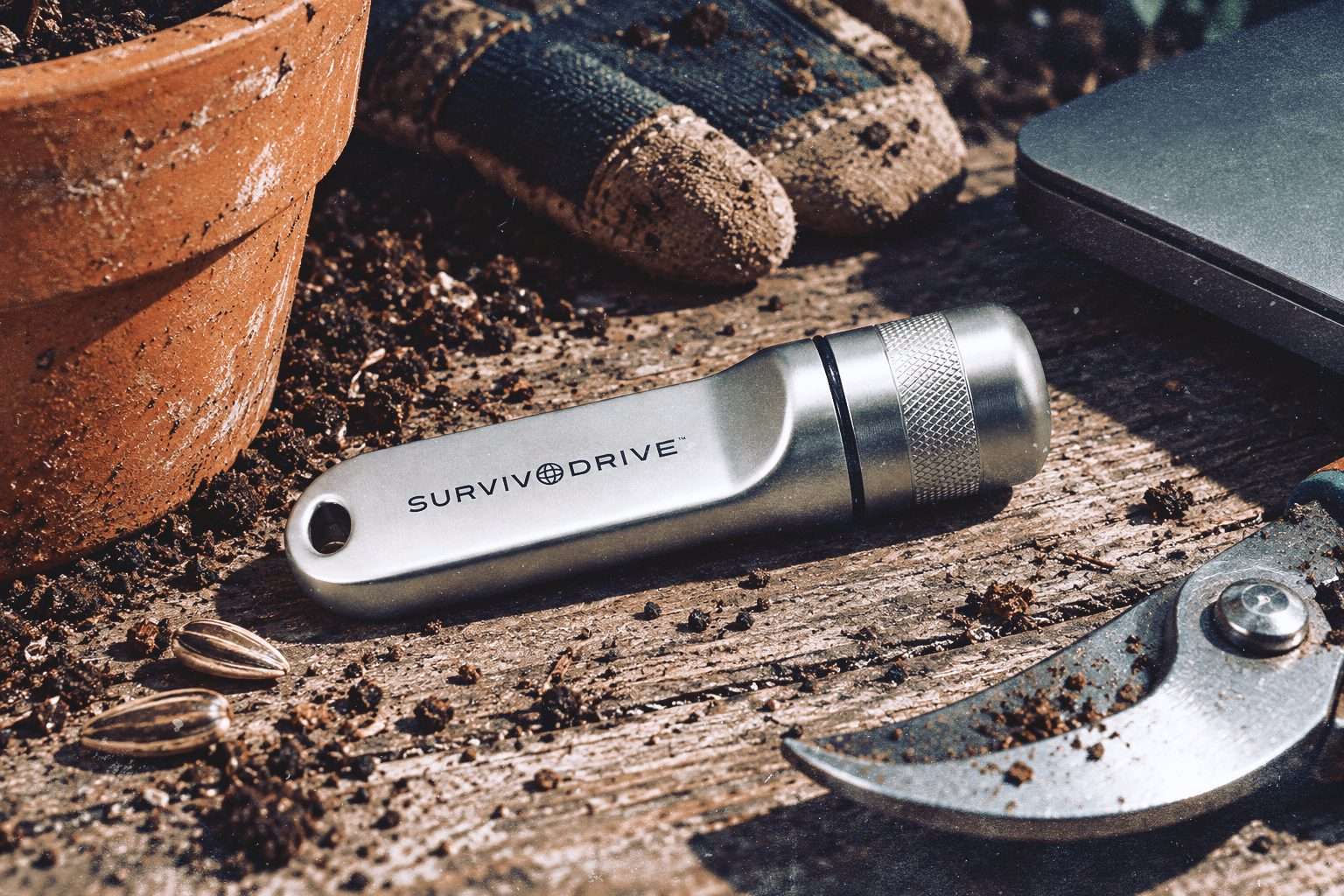
SURVIVODRIVE is a 256 GB USB drive that works with no internet. It plugs into a laptop, desktop or Raspberry Pi, and phones and tablets join over that computer’s Wi-Fi. For a smallholding it carries:
- Animal health: Where There Is No Animal Doctor and the WikiVet encyclopedia
- Poultry and rabbits: Small-scale Poultry Production and The Rabbit
- Soils and crops, small farm grain storage and freshwater fish ponds
- Seed saving guides, and how to store vegetables and fruit at home
- Welding and engines: the Steelworker and Construction Mechanic manuals
- 1,250 Project Gutenberg books on farming, forestry, beekeeping and fishing
- All of English Wikipedia with images, and an offline map of the UK
For a sick animal, call your vet first. The assistant, a small local LLM, answers from those books with numbered sources, and says “Not on this drive.” when the answer isn’t there. It can’t read the browse-only Gutenberg books. None of the manuals is written for UK law, so check feeding, medicines and disposal against the UK rules above. How the assistant works.
It is £69 with tracked UK delivery. It isn’t on sale yet: pre-orders open by email first, so join the pre-order list to hear the moment they do. See everything on it.
Questions
D-01Do I need a CPH number for chickens?
In England and Wales you must register any poultry with APHA within one month, even a few pet hens. With fewer than 50 birds and no CPH number, you can register online and APHA gives the holding a CPH. With 50 or more, you need a CPH from the Rural Payments Agency or Rural Payments Wales first. Scotland uses the free Scottish Kept Bird Register, and Northern Ireland uses DAERA’s Bird Register.
D-02How do I get a CPH number?
In England, apply to the Rural Payments Agency online through GOV.UK or on 03000 200 301, up to 6 weeks before the animals arrive; it passes your details to APHA for your flock or herd mark. In Wales, use Manage My CPH on RPW Online. In Scotland, register your business and land with Rural Payments and Services. In Northern Ireland, register with DAERA for a herd or flock number.
D-03Which animals need a CPH number?
In England: cattle, sheep, goats, pigs and poultry, even when kept as pets. It is voluntary for alpacas and llamas, and for deer unless you move them. Horses, ponies and donkeys need one only to be exported or moved to the EU or Northern Ireland, though each needs a passport. Wales lists cattle, deer, sheep, goats, pigs, poultry and equines for export. In Northern Ireland, alpaca keepers must register with DAERA from 30 September 2026.
D-04Can I feed kitchen scraps to my chickens or pigs?
No. GOV.UK says you must never feed farm animals kitchen scraps or catering waste, whether vegetable or meat, and that includes waste from vegan households. Backyard hens and pet pigs count: nidirect says feeding chickens kitchen waste, vegetable scraps included, is illegal, and for pigs catering waste includes used cooking oil. The rule stops diseases such as foot and mouth spreading through feed. Buy proper feed, and ask APHA if unsure.
D-05What do I need before I keep sheep?
In England: a CPH number, a flock mark from APHA, official ear tags, a holding register and a way to report moves to the Livestock Information Service. Tag lambs within 6 months if reared indoors or 9 months outdoors, or before they move. Update the register within 36 hours of a move, and return Defra’s annual inventory by 31 December. Find a vet and make a health plan before the sheep arrive.
D-06Is SURVIVODRIVE useful on a farm?
Yes, for the days the power or the signal goes. It carries Where There Is No Animal Doctor, a veterinary handbook for sheep, cattle, goats, pigs, poultry and draft animals, FAO manuals on poultry and rabbits, Peace Corps guides to soils, crops and grain storage, and 1,250 public-domain farming books to browse. For machinery and power there are TM 9-8000 Principles of Automotive Vehicles, the iFixit repair guides and a US Army manual on generator power. It runs on a laptop’s battery and shares to phones over Wi-Fi. For a sick animal, call your vet first.