The short answer
A rural emergency plan covers what the countryside makes harder: a phone that works in a power cut, a way to reach 999 with weak signal, safe water if a private supply fails, and enough at home to wait out a closed road.
Will your landline work in a power cut? An old analogue line might. A digital landline won’t without a battery back-up, and UK landlines are moving to digital now. Six things to do this week:
- Ask your provider if your landline is digital, and say if you rely on it
- Save 105 and join the Priority Services Register if you need extra help
- Plan how to keep warm when the boiler stops
- Check mobile coverage at home on Ofcom’s map
- Check when your private water supply was last tested
- Write the plan down and print it
The digital landline switchover
UK landlines are moving from the old telephone network to digital lines that run over broadband, and a digital landline needs mains power to work.
What is changing, and when
Ofcom says BT plans to retire its old landline network by 31 January 2027, and customers on the BT Openreach network should have moved to a digital landline, or a service that works the same way, by then. Virgin Media O2 and KCOM plan to retire their networks too, but no dates have been set.
Your phone will plug into the broadband router, not the wall socket, and some people need new equipment. Reply if your provider contacts you: Ofcom warns you might risk losing service if you don’t. Under the Fixed Telecoms Modernisation Charter of March 2026, the large providers have committed to give customers at least 60 days’ notice of a change that affects them.
Will my landline work in a power cut?
On the old analogue network, GOV.UK Prepare says a corded phone might still work. A digital landline won’t: Ofcom says digital landlines need mains electricity and will not work in a power cut unless there is a battery back-up. Your mobile may not help either, as Prepare warns it might stop if your local mast is in the affected area.
If you rely on your landline
If you don’t have a working mobile or a reliable signal, Ofcom says your provider must offer you a free back-up, such as a battery unit, lasting at least 1 hour in a power cut. Some last up to 7 hours. Tell your provider before the switch if you have no mobile or signal, if anyone at home has extra needs, or if an alarm uses the phone line.
Telecare and personal alarms
Ofcom says a care alarm or telecare device might not work properly on a digital landline, so tell your provider and the alarm supplier before the switch. If needed, the provider can pause the change until a safe solution is in place. The government’s Telecare National Action Plan adds that an alarm connected through a router with no battery back-up won’t work in a power cut.
Long power cuts
Call 105 to report a power cut or get updates, join the Priority Services Register if anyone at home needs extra help, and plan for heating that stops when the power does.
105 is free from most landlines and mobiles in England, Scotland and Wales, and puts you through to your local electricity network operator. In Northern Ireland, call NIE Networks on 03457 643643. See our power cut guide.
When the boiler stops
GOV.UK Prepare says boilers and heat pumps won’t work without power. NIE Networks, which runs Northern Ireland’s electricity network, says gas and oil central heating boilers generally won’t work without electricity to power their pumps. An LPG boiler is a gas boiler, so a full tank doesn’t mean a warm house.
NIE Networks suggests staying in one room, or even in bed, to keep warm. If you run a generator, site it carefully because of the risk of carbon monoxide, with plenty of air flow, and fit a carbon monoxide alarm.
The Priority Services Register
The Priority Services Register is free extra help from your energy supplier and network operator. Ofgem says you can apply if you have reached state pension age, have young children, or live with a disability or long-term condition, among other reasons. In a power cut, network operators must offer people on it extra help, such as battery packs to charge phones or medical equipment.
Payments for long power cuts
If your power is off for more than 12 hours in normal weather, or more than 24 hours when over 5,000 properties are affected, Ofgem says your network operator pays a household £100 automatically, plus £45 for each further 12 hours. Severe weather has its own rules.
No mobile signal
Check your coverage on Ofcom’s map before you rely on a mobile. A 999 call will use any network it can find, but it can’t connect with no network at all.
Check your coverage
Ofcom’s Map Your Mobile checker shows, by postcode, whether EE, O2, Three and Vodafone have a 4G or 5G signal indoors or outdoors. Brands such as Tesco Mobile and giffgaff run on one of those four. Buildings, trees, hills and weather all affect reception, Ofcom notes, so test it around the house and garden.
If indoor signal is poor, Ofcom suggests Wi-Fi calling, which uses your broadband, so it stops in a power cut with the router. Ofcom also lists indoor mobile repeaters that are legal without a licence; others remain illegal, so check the exact model first.
Calling 999 with no signal
GOV.UK Prepare says emergency calls automatically roam onto any available network, so a 999 call can get through on another operator’s mast. Ofcom is clear about the limit: when a phone is out of coverage of any network, it is not possible to make an emergency call. Moving a short distance can sometimes help, Prepare notes, so find your nearest reliable spot now.
People who are deaf, hard of hearing or speech-impaired can text 999 through emergencySMS, but must register first: text “register” to 999, then reply “yes”. A text still needs a signal.
Private water supplies
If your water comes from a borehole, spring, well or stream rather than a water company, you are on a private supply. Your council or, in Northern Ireland, the Drinking Water Inspectorate oversees it, but most of the upkeep falls to the owner.
About 1% of people in England and 3% in Wales use one, says the Drinking Water Inspectorate (DWI), and about 2.5% in Scotland, says the Drinking Water Quality Regulator (DWQR).
Who regulates and tests it
- England and Wales: councils regulate under the Private Water Supplies (England) Regulations 2016 and (Wales) Regulations 2017, with the DWI advising councils. For a supply serving only your own home, the council doesn’t have to risk-assess or test it unless you ask, and it can charge. Supplies to rented homes or businesses must be risk-assessed and monitored.
- Scotland: councils regulate, supervised by the DWQR. Supplies serving 50 or more people, or used commercially, such as a holiday let, come under the Water Intended for Human Consumption (Private Supplies) (Scotland) Regulations 2017. Smaller Type B supplies, many serving a single house, come under the Private Water Supplies (Scotland) Regulations 2006 and are tested only when the owner or users ask. mygov.scot lists a grant of up to £800 per property, through your council, for improvements such as treatment.
- Northern Ireland: the Drinking Water Inspectorate regulates supplies serving more than one household or used in commercial food and drink production, under the Private Water Supplies Regulations (Northern Ireland) 2017. A well serving a single home isn’t monitored, but your council’s environmental health department can test it if you ask.
For a test, ask your council’s environmental health team. The DWI notes that water quality changes with the seasons, so one result isn’t necessarily representative.
If the supply fails
In England and Wales, the DWI’s guidance on supplies running short says neither the council nor the water company has to provide another supply unless there is a danger to life or health, and even then the cost of bottles or tankers can be recovered from the people served. It lists pump failure as one cause and recommends planning ahead, as mygov.scot does for Scottish owners.
- Keep bottled water: GOV.UK Prepare suggests at least 2.5 to 3 litres of drinking water per person per day. Our supply calculator works out your total.
- If your supply has an electric pump or a UV treatment unit, ask your installer what happens in a power cut.
- If the water looks, smells or tastes wrong, don’t drink it, and contact your council. See making water safe to drink and what to do with no water supply.
Snow, floods and being cut off
If snow, flood water or fallen trees close the road, plan to manage at home until it opens: food, medicine, water, warmth, light and the news.
GOV.UK Prepare’s cold weather advice is to check you have enough medication and food in case it is harder than usual to leave the house, and to heat the rooms you use most to at least 18°C. Check the oil or LPG tank before winter.
- A torch or LED lantern, with spare batteries
- A battery or wind-up radio for news
- Charged power banks (our power bank calculator sizes them)
- Bottled water and food that needs no cooking
- Enough regular medicine, and a home first aid kit
Our power cut food safety tool tells you what food to keep. See our guides to snow and ice, storms, floods and stuck in a car in snow. Live Watch brings together Met Office warnings for your area, flood warnings near your postcode in England and live power cuts, updated every 5 minutes.
Your household plan
Write the plan on a single sheet, print it, and keep it where you’d look for it in the dark.
Start from the government template in our household emergency plan guide, then add:
- Numbers on paper: 999, 105 (03457 643643 in Northern Ireland), your phone provider, your oil or LPG supplier, your council’s environmental health team, your GP, your vet and your neighbours
- Which phone works in a power cut, and where the battery back-up unit is
- The best spot for mobile signal, and which networks reach it
- Where the fuse box, stopcock, water tank and any pump or treatment unit are
- How you will keep warm if the boiler stops
- Neighbours who might need a knock on the door, such as anyone living alone or on telecare
When the broadband goes
When the broadband and the signal are both down, a search engine is no help. An offline library on a USB drive still is.
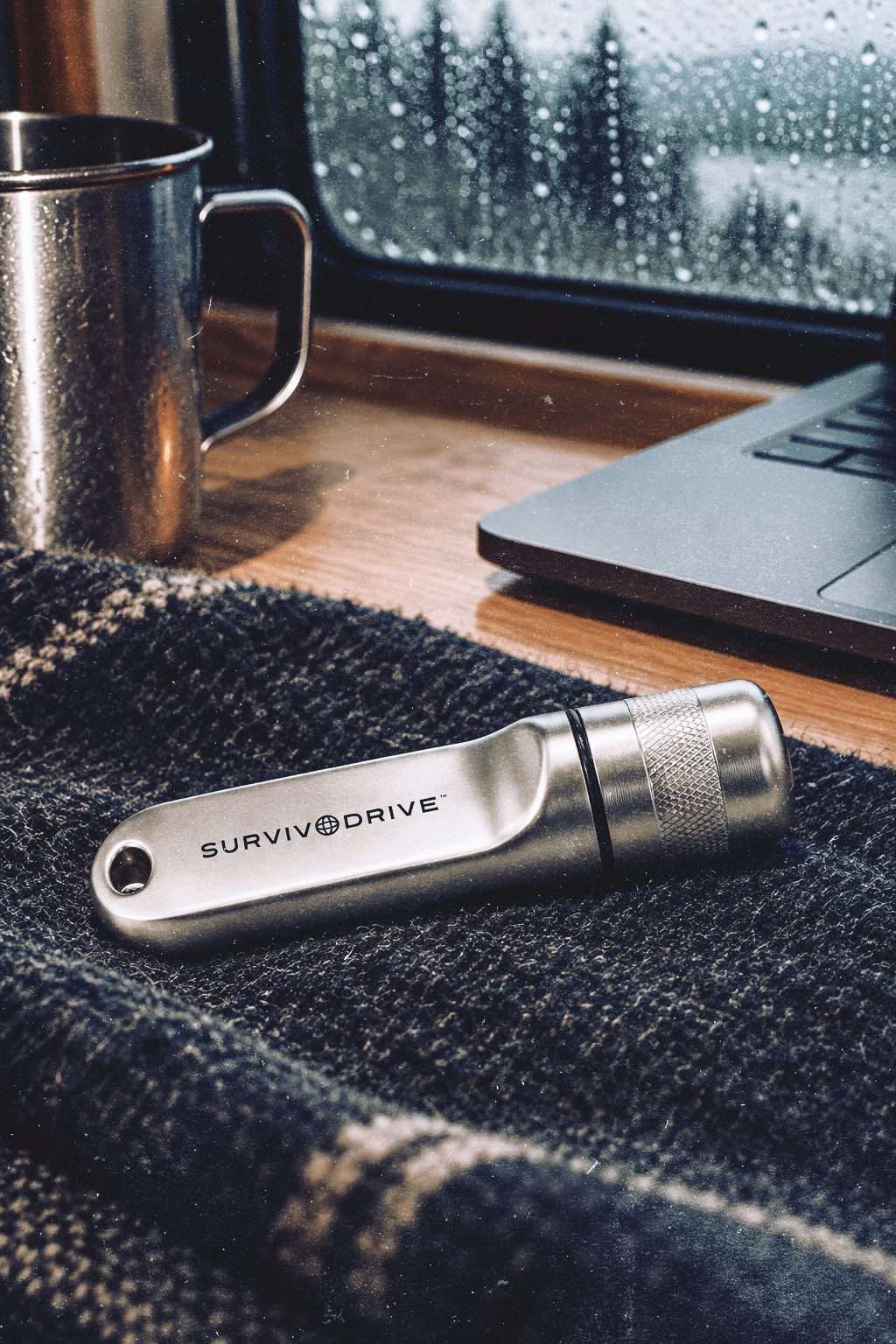
SURVIVODRIVE is a 256 GB USB drive that works with no internet. Plug it into a laptop or desktop and it opens all of English Wikipedia with images, field manuals, an offline OpenStreetMap of the UK and a small local LLM assistant that answers from the drive’s own books with numbered sources. In a power cut it runs on the laptop’s battery, and phones join over Wi-Fi or a laptop hotspot, so one charged laptop serves the house.
- First aid with no signal: 12 emergency quick cards, WikEM and the NHS’ Medicines A to Z
- Power and repair: ATP 3-34.45 Electric Power Generation and Distribution, and iFixit in English
- Core emergency guides as plain PDFs that open on a phone with no computer running
It can’t call for help, and it needs a laptop, desktop or Raspberry Pi; without one, an Android phone can read the library with Kiwix from the drive, and an iPhone can open the emergency PDFs.
It is £69 with tracked UK delivery. It isn’t on sale yet: pre-orders open by email first, so join the pre-order list to hear when they do. See what’s on it.
Questions
D-01Will my landline work in a power cut?
A digital landline won’t, unless it has a battery back-up: Ofcom says digital landlines, which plug into your broadband router, need mains electricity to work. A corded phone on an old analogue line might still work, GOV.UK Prepare says. If you rely on your landline and have no working mobile or reliable signal, Ofcom says your provider must offer a free back-up, such as a battery unit, lasting at least 1 hour.
D-02When is the digital landline switchover?
Ofcom says BT plans to retire its old landline network by 31 January 2027, and customers on the BT Openreach network should have moved to a digital landline, or a service that works the same way, by then. Virgin Media O2 and KCOM plan to retire their networks too, but no dates have been set. Ask your provider whether you are affected, and reply if they contact you about the change.
D-03Can I call 999 if my mobile network has no signal?
Often, yes. GOV.UK Prepare says emergency calls automatically roam onto any available network, so a 999 call can connect through another operator’s mast. But Ofcom says that when a phone is out of coverage of any network, an emergency call is not possible. Check coverage at home on Ofcom’s Map Your Mobile checker, find your nearest reliable spot, and if you rely on a digital landline, ask your provider about a battery back-up.
D-04Who tests a private water supply?
Your local council, in England, Wales and Scotland. For a supply serving only your own home, the council tests it when you ask, and in England and Wales it can charge. Supplies to businesses, such as holiday lets, are regulated more closely. In Northern Ireland, the Drinking Water Inspectorate regulates shared and commercial supplies, and your council’s environmental health team can test a single-home well if you ask.
D-05What should a rural emergency plan include?
Phone numbers on paper, including 105 for power cuts (03457 643643 in Northern Ireland); which phone works in a power cut; where mobile signal is best; how you will keep warm when the boiler stops; where the stopcock, fuse box and any water pump are; bottled water, food that needs no cooking and regular medicine; and which neighbours might need a check. Join the Priority Services Register if anyone at home needs extra help.
D-06Is SURVIVODRIVE useful in a rural home?
Yes, for the days the broadband, power or signal goes. SURVIVODRIVE is a 256 GB USB drive that works with no internet: all of English Wikipedia with images, field manuals, first aid, an offline UK map and a small local LLM assistant that answers from the drive with sources. It runs on a laptop’s battery and shares to phones over Wi-Fi or a laptop hotspot. It can’t make calls, so keep a working phone for 999. It is £69 with tracked UK delivery, and pre-orders open by email first.