Van life essentials: the short checklist
Most of what keeps a van trip safe is dull: power, water, two alarms, a first aid kit and a plan for no signal.
Each item links to the section that explains it, with the UK advice behind it:
- A power bank for phones, separate from the leisure battery
- Drinking water: at least 2.5 to 3 litres per person per day
- A carbon monoxide alarm
- A smoke alarm, a fire blanket and a dry powder extinguisher by the door
- A first aid kit, your medicines and emergency numbers on paper
- Maps downloaded before you go, a paper road atlas and a compass
- A torch, warm clothes, blankets, high-visibility clothing and jump leads
- In winter: an ice scraper, de-icer and a shovel
- A plan for where you’ll sleep tonight, and a second one
- An offline library for repairs, first aid and maps
Power: leisure battery, solar and power banks
Know what your leisure battery can run, and keep a separate power bank for the phones.
The leisure battery runs the lights, fridge, pump and sockets. Learn how long it lasts on a normal evening before you park without a hook-up. Solar tops it up while you’re parked, but less on short winter days.
Don’t idle the engine to charge on a public road: Highway Code rule 123 says you must not leave an engine running unnecessarily while stationary. Keep a charged power bank so a flat leisure battery never leaves you without a phone; our power bank calculator shows how many charges a given size gives.
Run any generator outside. The NHS lists portable generators among the things that make carbon monoxide.
Water and waste
Carry more drinking water than you think, and treat anything that didn’t come from a tap.
GOV.UK Prepare gives a minimum of 2.5 to 3 litres of drinking water per person per day, and 10 litres once cooking and basic hygiene are included. For 2 people on 3 days away from a tap, that is 15 to 18 litres to drink, or about 60 litres for everything. How much water to store.
UK tap water is safe without boiling, the Drinking Water Inspectorate says. Water from a burn, river or loch is untreated: bring it to a rolling boil, which kills bacteria, viruses and parasites, and let it cool naturally. How to make water safe to drink.
Empty toilet cassettes only at proper disposal points. The Highland Council asks motorhome users never to empty them into public toilets, because rural ones often run on small septic systems that can’t cope.
Gas, heat and carbon monoxide
Anything in the van that burns fuel can make carbon monoxide, and you can’t see or smell it.
The NHS advises a carbon monoxide alarm that makes a loud sound in every room with an appliance that burns gas, oil, coal or wood. In a van, that is the living space. Have the hob, heater and gas system properly installed and serviced regularly by a qualified engineer.
Keep the air vents clear: Cheshire Fire and Rescue Service warns that blocked vents can be fatal. Turn the gas cylinder off when you’re not using it. Never use a barbecue, camping stove, camping heater, fuel lantern or charcoal grill inside the van: the same advice says opening the doors and windows is not enough.
Signs of carbon monoxide poisoning
Headache, dizziness, feeling sick, weakness, tiredness and confusion, which may ease when you go outside. Stop using the appliance, get into fresh air and get medical advice. Call 999 if someone is struggling to breathe, suddenly confused or unconscious, and don’t drive yourself to A&E, the NHS says. What to do if a CO alarm goes off.
If you smell gas, turn off every appliance and the cylinder valve, open the doors and windows, and don’t smoke or touch electrical switches. What to do if you smell gas.
Fire safety
Fit a smoke alarm, keep a blanket and an extinguisher by the door, and get out first.
Cheshire Fire and Rescue Service’s caravan advice suits a van too: a smoke alarm (optical alarms are usually the most effective), a fire blanket and a dry powder extinguisher near the door. Its everyday rules:
- Turn appliances off before you sleep or leave the van.
- Never use a cooker or heater while the vehicle is moving.
- Don’t leave pans unattended, or dry clothes over the stove.
- Never smoke in bed.
If a fire starts, get everyone out, then call 999. Give a map reference if you can, or a nearby landmark such as a farm. What to do in a fire.
First aid
Carry a proper kit, and know how to use it before you need it.
Keep a first aid kit where everyone can reach it, with enough of your own medicines for the whole trip. Our first aid kit guide lists what to pack, and our CPR guide and hypothermia guide are worth reading before a cold trip.
Write emergency contacts and medical details on paper too. GOV.UK Prepare suggests a paper copy of important numbers in case your phone loses power.
No signal: 999, campervan Wi-Fi and offline maps
Plan for no signal: download or print your maps, keep numbers on paper, and know how 999 behaves.
Calling 999 when your network has no signal
GOV.UK Prepare says that even if there’s an issue with your own mobile network, emergency calls automatically roam onto any available network. That needs some network to reach you; where none does, moving a short distance can sometimes find one. A 999 call is free, so it works with no credit (Leicestershire Fire and Rescue Service). With Wi-Fi but no mobile network, Wi-Fi calling may still work.
Campervan Wi-Fi
Check coverage where you’re heading on Ofcom’s coverage checker. A mobile router with a roof aerial can make a weak signal usable, but can’t create one. Satellite broadband, and newer satellite services that connect directly to phones, can help when land-based networks are down, GOV.UK Prepare notes, though availability and performance vary.
Offline maps in the UK
Save the areas you need in your phone’s map app while you have Wi-Fi. Your phone’s GPS may still work with no signal, Prepare says, but map apps need maps downloaded in advance to show routes. Carry a paper road atlas too, as the Met Office suggests, and a walking map and compass for days on foot. Before you lose signal, check Live Watch for UK warnings and power cuts.
Breakdowns and winter
Stop somewhere safe, get away from the traffic, and carry enough to stay warm while you wait.
The Highway Code says to stop in a place of relative safety, such as a service area or a lay-by. If you can’t leave a motorway, go left: into the left lane, then onto the hard shoulder or into an emergency area, hazard lights on (rule 277). On other roads, put a warning triangle at least 45 metres behind the van, but never on a motorway (rule 276).
Rule 91 recommends a break of at least 15 minutes every 2 hours. If you feel sleepy, stop somewhere safe, but not on a hard shoulder or in an emergency area.
For winter, the Met Office’s car kit list suits a van: ice scraper and de-icer, a torch with spare batteries or a wind-up one, warm clothes and blankets, high-visibility clothing, jump leads, an empty fuel can, food and a hot drink in a flask, and a shovel. See the winter car kit, stuck in snow and snow and ice.
Where you can and can’t park overnight
Scotland’s access rights cover camping in a tent, not in a van. Elsewhere in the UK there is no general right to camp.
Scotland
You can camp lightly in a tent, in small numbers, for 2 or 3 nights in one place, but NatureScot’s access code guidance says access rights don’t include motor vehicles. The Highland Council is plain: stopping overnight in a motorhome outside a formal site is not wild camping under the Code, and a rooftop tent counts as part of the vehicle.
Its Highland guidance: you may rest overnight in a designated lay-by if everything stays inside the van (no awnings, chairs or cooking outside). In lay-bys and car parks, follow the parking conditions shown and be ready to move. Don’t park on verges, and never in a passing place, which is illegal. Off-road, you need the landowner’s permission.
In Loch Lomond & The Trossachs National Park, seasonal camping management zones run from 1 March to 30 September, with motorhome permit areas where a permit lets you stay up to 3 nights. The byelaws are under review, so check before you go.
England and Wales
The Countryside Code for England and Wales lists camping among the things you may need the landowner’s permission for. On Dartmoor, the National Park Authority says its byelaws stop you parking a motorhome or campervan overnight in lay-bys, at the roadside or in car parks; backpack camping is allowed only in the areas on its camping map.
Northern Ireland
Most land is private, and access depends on the owner’s goodwill, nidirect’s Countryside Code says. Ask first.
Lay-bys and roadsides, anywhere
Read the signs: councils and landowners set their own rules. The Highway Code says you must not park on a road at night facing against the traffic unless in a recognised parking space (rule 248), and every vehicle must show parking lights on a road or lay-by where the limit is over 30 mph (rule 249). A campsite, or a landowner who has said yes, is the surest night’s sleep.
An offline library for the van
Where there’s no signal to look things up, carry the books.
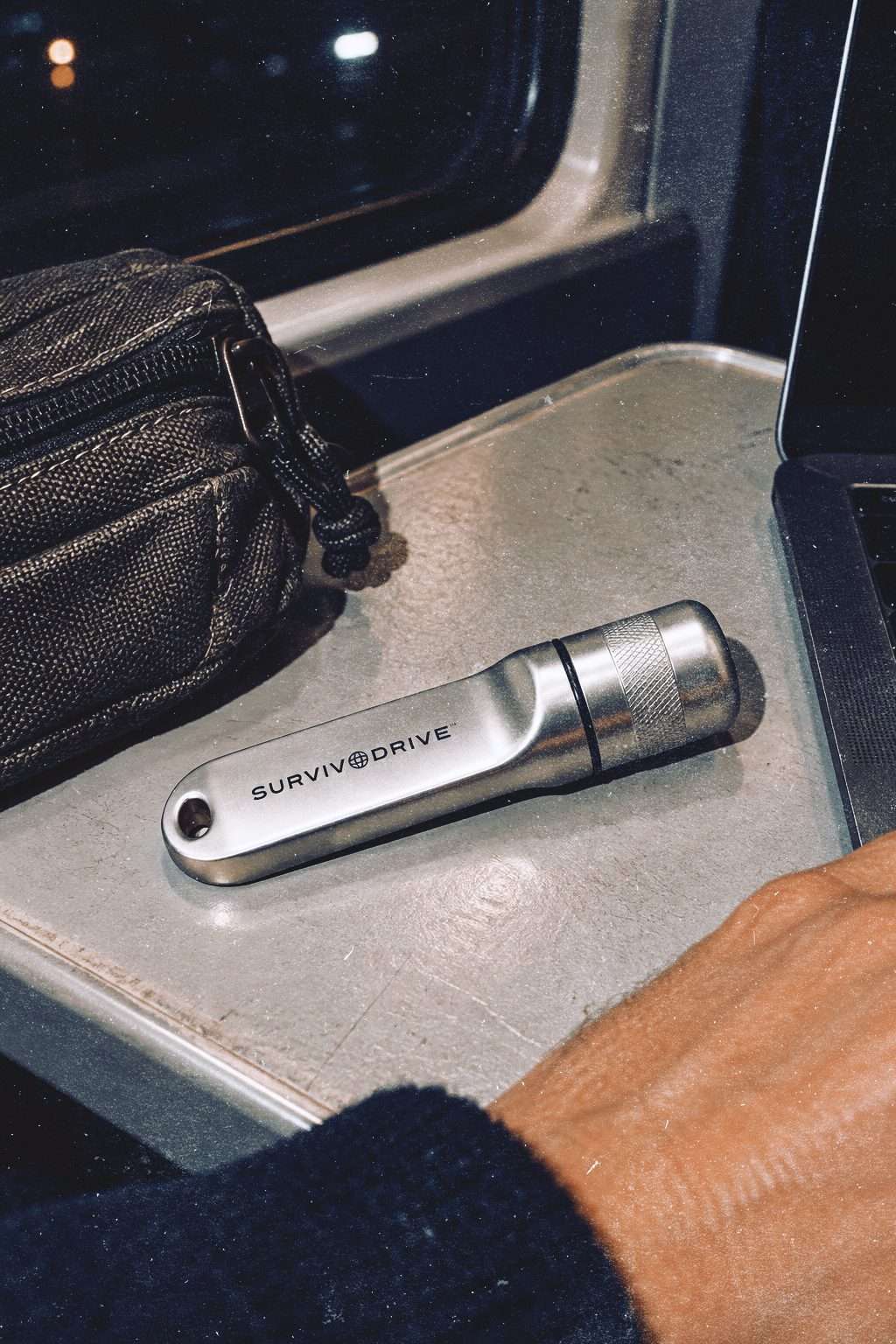
SURVIVODRIVE is a 256 GB USB drive holding all of English Wikipedia with images, field manuals, first aid, a UK map and a small local LLM assistant that answers from those books with numbered sources, all working with no internet. For a van:
- An offline OpenStreetMap map of the UK (1.9 GB): roads, paths, towns and landmarks.
- iFixit in English: 100,000 step-by-step repair guides, vehicles included.
- TM 9-8000 Principles of Automotive Vehicles, and Construction Mechanic Basic, Volume 1 (NAVEDTRA 14264), on petrol and diesel engines, fuel and electrics.
- Photovoltaic Power Systems and the National Electrical Code: Suggested Practices, a US guide to wiring solar panels, charge controllers, batteries and inverters, and energypedia.
- Wikivoyage, the travel guide, with maps and photos.
- First aid manuals such as Where There Is No Doctor: A Village Health Care Handbook, and for cold nights, TC 21-3 Soldier’s Handbook for Individual Operations and Survival in Cold-Weather Areas.
Running it in a van
The drive needs a laptop, desktop or Raspberry Pi. On Windows or Mac you double-click one file; nothing is installed. A laptop draws about 10 to 20 W while you read and 30 to 60 W for a minute or two while the assistant writes. The assistant starts switched off, and there’s a low battery mode.
No laptop? A Raspberry Pi 4 or 5 runs the library and the assistant, and phones and tablets, iPads included, join it over Wi-Fi. Give the Pi its own proper power supply: we haven’t tested it from a van’s USB socket. With no computer, an Android phone can read the library with the reader app in the drive’s ANDROID folder, and an iPhone or iPad can open the plain PDFs in the EMERGENCY folder.
Store it cool and dry: heat speeds data loss in flash memory, so not on a summer dashboard.
It is £69 with tracked UK delivery. It isn’t on sale yet: pre-orders open by email first, so join the pre-order list to hear the moment they do. See what’s on it, or how it works.
Questions
D-01What are the van life essentials in the UK?
The van life essentials for UK trips are mostly safety basics: a power bank separate from the leisure battery, at least 2.5 to 3 litres of drinking water per person per day, a carbon monoxide alarm, a smoke alarm, a fire blanket and a dry powder extinguisher, a first aid kit, maps downloaded or on paper, warm clothes and a winter kit, and a plan for where you can legally park overnight.
D-02Can you wild camp in a campervan in Scotland?
No. Scotland’s access rights cover lightweight camping in a tent, but NatureScot’s guidance says they don’t include motor vehicles, and the Highland Council says stopping overnight in a motorhome outside a formal site is not wild camping under the Scottish Outdoor Access Code. Its guidance allows resting overnight in a designated lay-by if everything stays inside the van, but never in a passing place. Off-road, you need the landowner’s permission.
D-03Can you sleep in a campervan anywhere in England and Wales?
No. England and Wales have no general right to camp: the Countryside Code lists camping among the things you may need the landowner’s permission for. Some places forbid overnight vehicle stays, such as Dartmoor, where the National Park Authority’s byelaws stop motorhomes and campervans parking overnight in lay-bys, at the roadside and in car parks. Use a campsite, ask the landowner, or follow the signs.
D-04Can I call 999 if my mobile network has no signal?
Yes, if any network reaches you. GOV.UK Prepare says that even if there’s an issue with your own mobile network, emergency calls automatically roam onto any available network. Where no network reaches at all, a phone can’t connect, and moving a short distance can sometimes find a signal. A 999 call is free, so it works with no credit, and with Wi-Fi but no mobile network, Wi-Fi calling may still work.
D-05How do I use maps with no signal in a campervan?
Download maps before you lose signal. GOV.UK Prepare notes that your phone’s GPS may still work with no signal, but map apps need maps downloaded in advance to show routes. Carry a paper road atlas, as the Met Office suggests, and a walking map and compass. SURVIVODRIVE also holds an offline OpenStreetMap map of the UK (1.9 GB) showing roads, paths, towns and landmarks, opened on a laptop, desktop or Raspberry Pi with no internet.
D-06Should I have a carbon monoxide alarm in a campervan?
Yes, if anything in it burns fuel, such as a gas hob or a diesel heater. The NHS advises a carbon monoxide alarm in every room with an appliance that burns gas, oil, coal or wood, and warns that the gas has no colour or smell. Never use a barbecue, camping stove or camping heater inside: Cheshire Fire and Rescue Service says opening doors and windows is not enough to stop it building up.
D-07Can I use SURVIVODRIVE in a campervan without a laptop?
Yes, with a Raspberry Pi 4 or 5 in the laptop’s place. Started from a terminal with sh start-linux.sh, it runs the full library and the assistant, and phones and tablets, iPads included, join it over Wi-Fi. With no Pi, an Android phone can install Kiwix and PocketPal AI from the drive’s ANDROID folder and read the library on its own, though the chat app answers without library sources, and an iPhone or iPad can open the EMERGENCY PDFs in the Files app.